How to Make a Sales Pitch [with Examples] That Close Deals

How to Make a Sales Pitch [with Examples] That Close Deals
Introduction
A sales pitch is your opportunity to demonstrate value, address concerns, and inspire action in minutes. Yet most pitches fail because reps focus on features instead of benefits, talk too much without listening, or fail to customize messaging for specific prospects.
This guide provides a proven framework for creating and delivering effective sales pitches, with real examples, customization strategies, and techniques used by top-performing sales professionals.
Primary Keyword: Sales pitch Secondary Keywords: Sales pitch examples, how to pitch, sales presentation, pitch techniques Keyword Clusters: Pitch structure, delivery techniques, customization, examples
What is a Sales Pitch?

A sales pitch is a concise presentation explaining how your product or service solves specific problems or creates value for prospects. Effective pitches are conversations, not monologues combining storytelling, questioning, listening, and demonstrating value.
Duration: Elevator pitch (30-60 seconds), phone pitch (2-5 minutes), meeting pitch (15-45 minutes), formal presentation (45-90 minutes)
Goal: Not to close immediately but to advance to next step whether meeting, demo, proposal, or trial.
The PACES Sales Pitch Framework
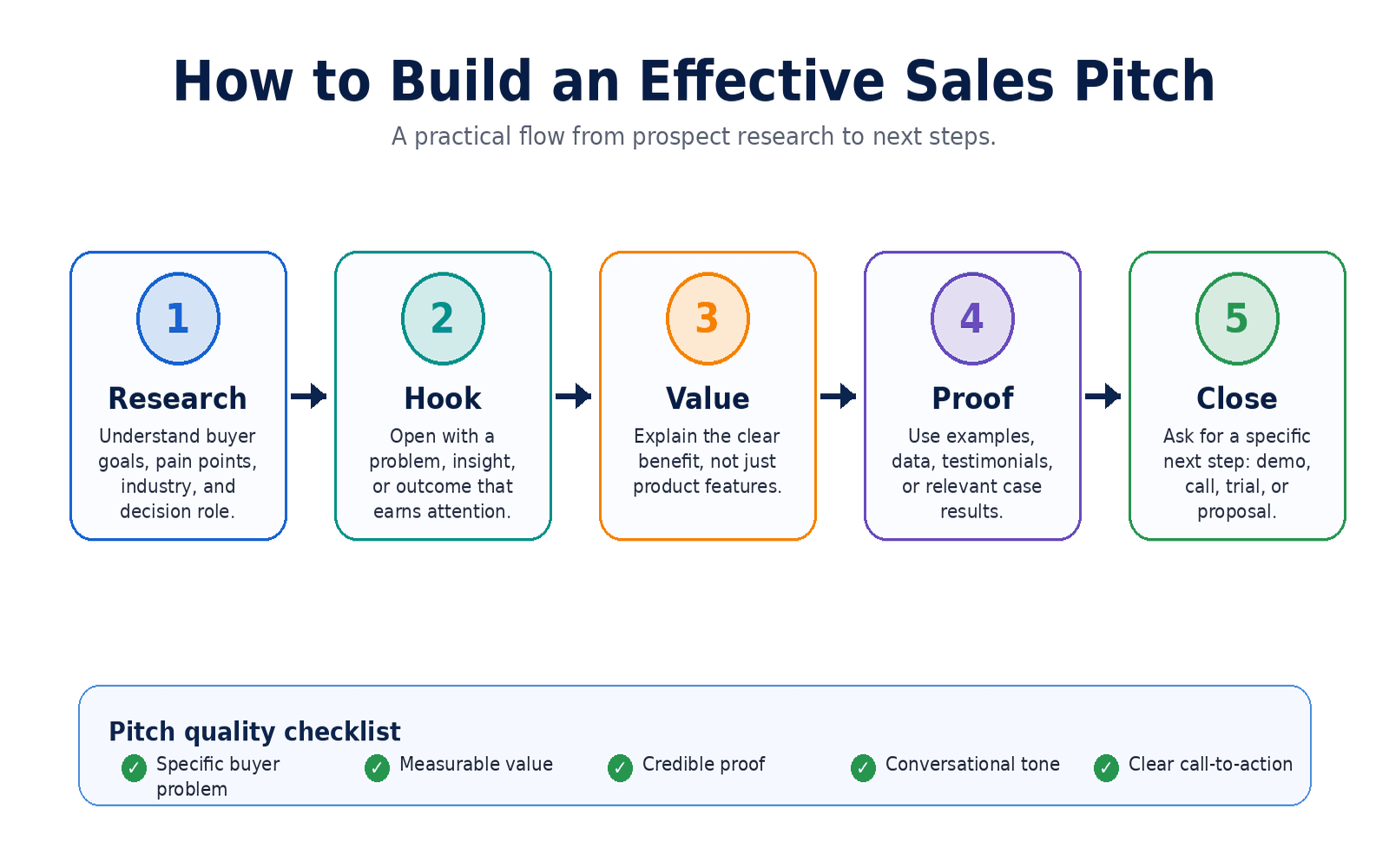
P - Problem: Identify specific pain point A - Amplify: Explore impact and consequences C - Connect: Show understanding and empathy E - Evidence: Demonstrate solution with proof S - Solution: Present your offering clearly
Opening: Hook Their Attention (30 seconds)
Attention-Grabbing Openers:
Provocative Question: "What if you could reduce customer churn by 40% without hiring more support staff?"
Surprising Statistic: "Companies in your industry waste an average of 23 hours weekly on manual data entry that's nearly $50,000 annually per employee."
Relevant Story: "Last quarter, a CFO told me they'd tried three different accounting systems and still couldn't get real-time visibility..."
Common Mistake: Don't open with company history or product features. Lead with prospect value.
Problem Identification (1 minute)
Demonstrate understanding of their specific challenges.
Template: "Based on our conversation and what I know about [industry/company], you're likely facing [specific challenge]. This typically means [consequence 1], [consequence 2], and [consequence 3]."
Example: "Growing SaaS companies like yours typically struggle with forecast accuracy as sales cycles lengthen and deal complexity increases. This usually results in missed revenue targets, inefficient resource allocation, and board pressure."
Key: Be specific, not generic. Reference their industry, size, or situation.
Amplify the Pain (1 minute)
Help them feel the full impact of their problem.
Questioning Technique:
"How much time does your team spend on [problem] weekly?"
"What's the cost when [problem occurs]?"
"How does this impact your ability to [strategic goal]?"
Example: "When forecasts miss by 15-20% quarterly, how does that affect your hiring decisions? What opportunities might you miss while being conservative with budgets?"
Goal: Not to manipulate but to ensure they understand full problem scope.
Connect and Build Trust (1 minute)
Show empathy and demonstrate you understand their world.
Template: "I've worked with [number] companies in [their industry/situation], and this challenge is incredibly common. [Similar company] dealt with exactly this before implementing [approach]."
Example: "I've helped 15 Series B SaaS companies navigate this exact challenge. The reality is, spreadsheet-based forecasting breaks down once you hit $5M ARR and multiple sales segments. It's not anyone's fault it's a scaling issue every growing company faces."
Key: Validate their experience, show you've seen this before.
Evidence: Prove Your Solution Works (2-3 minutes)
Provide concrete proof your solution delivers results.
Case Study Example: "[Similar Company] faced the same forecasting challenges last year. After implementing our solution, their forecast accuracy improved from 68% to 94% within one quarter. More importantly, this visibility enabled them to confidently invest in growth ahead of revenue realization, accelerating their path to their Series C."
Data Points: Specific results, timeframe to results, comparable situation, tangible outcomes
Proof Types: Customer testimonials, case studies with metrics, product demos, third-party validation, free trial results
Solution Presentation (3-5 minutes)
Present your offering focused on benefits, not features.
Feature → Benefit Translation:
Feature: "Our platform includes AI-powered forecasting" Benefit: "This means you'll know within 5% accuracy what revenue to expect 90 days out enabling confident hiring and investment decisions"
Feature: "We integrate with Salesforce and HubSpot" Benefit: "Your team uses the CRM they're already comfortable with while getting better insights automatically"
Template: "Our solution addresses [problem] through [approach]. Specifically, you'll be able to [benefit 1], [benefit 2], and [benefit 3]. Here's how it works..."
Keep It Simple: Focus on 3-5 key benefits matching their priorities. Don't feature dump.
Handling Objections (2-3 minutes)
Anticipate and address concerns proactively.
Common Objections:
Price: "I understand budget is a consideration. Let me show you the ROI calculation based on [their specific situation]..."
Timing: "I appreciate timing concerns. What I've found is that delaying often costs more than the solution itself. In your case, each month waiting costs approximately [calculate impact]..."
Current Solution: "Your existing approach has clearly worked to get you this far. The question is whether it scales to [their goal]. Companies at your stage typically find..."
Competition: "Great question about [competitor]. The key difference is [specific differentiator relevant to their needs]..."
Technique: Acknowledge → Empathize → Reframe → Evidence
Call-to-Action: Next Steps (1 minute)
Be specific about what happens next.
Weak CTA: "So, what do you think?" Strong CTA: "Based on what we've discussed, the logical next step is a 45-minute technical deep-dive with your CTO next week. I can show specifically how our system integrates with your existing stack. Does Tuesday or Thursday work better?"
Always Include: Specific action, timeline, who's involved, what will happen, value of next step
Complete Pitch Example (5-Minute Version)
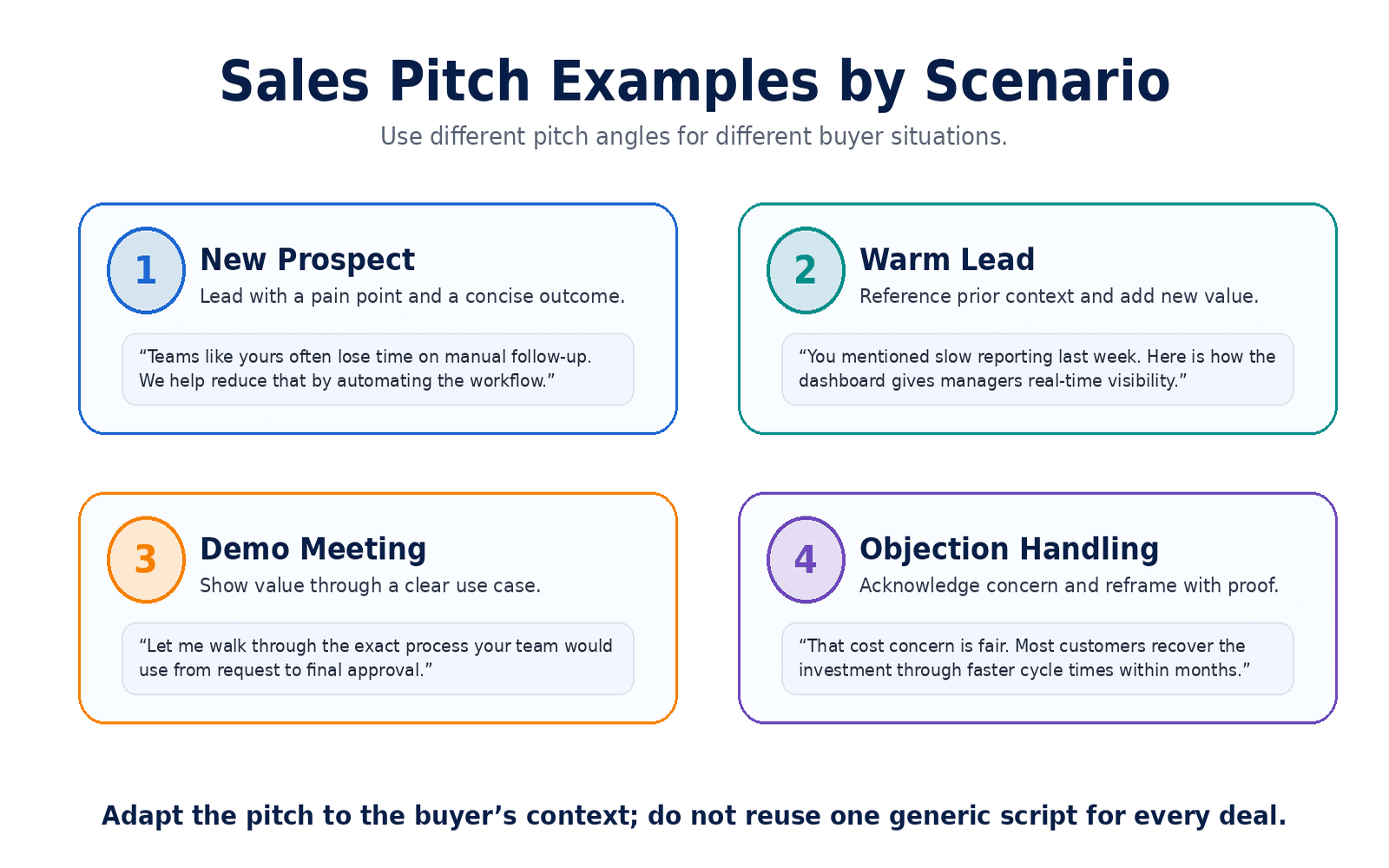
[Opening - 30 sec] "What if you could reduce customer support costs by 35% while improving satisfaction scores? Last year, companies your size spent an average of $450,000 on support yet 60% of tickets were repetitive questions that automation could handle."
[Problem - 1 min] "As customer bases grow past 1,000 accounts, support teams get overwhelmed with basic questions. Your team probably spends hours daily answering 'How do I reset my password?' or 'Where's my invoice?' Meanwhile, complex issues requiring expertise get delayed."
[Amplify - 1 min] "This creates a vicious cycle: good support people get burned out on repetitive work, they leave, hiring becomes urgent, new people need training, and quality suffers. What does a 30-day time-to-productivity for new support hires cost you?"
[Connect - 45 sec] "We've helped 40 B2B SaaS companies solve exactly this. The pattern is always the same support can't scale linearly with customer growth. Something has to change."
[Evidence - 1.5 min] "TechCo had this exact situation last year. They implemented our AI-powered help center and chatbot. Result: 68% of tier-1 questions automated, average resolution time dropped from 4 hours to 45 minutes, and they actually reduced headcount through attrition while supporting 40% more customers. Here's their CTO's testimonial..."
[Solution - 1.5 min] "Our platform combines three things: smart knowledge base that learns from every ticket, AI chatbot handling routine questions 24/7, and seamless handoff to human agents when needed. Your customers get instant answers to simple questions, your team focuses on complex issues where they add real value, and you scale support without proportional cost increases."
[CTA - 30 sec] "I'd like to show you specifically how this would work with your current ticket volume and types. Can we schedule a 30-minute demo where I'll use your actual support data to show potential impact? Thursday at 2pm?"
Customization by Scenario
Cold Call Pitch (2 minutes): Focus on problem and one compelling proof point. Goal: Get meeting, not close deal.
Discovery Meeting Pitch (15 minutes): More time for questioning and exploration. Multiple examples and deeper solution explanation.
Formal Presentation (45 minutes): Comprehensive with demos, detailed ROI, team introductions, multiple case studies.
Email Pitch (150 words): Concise problem statement, one proof point, clear CTA for meeting.
Delivery Best Practices
Pace and Pausing: Speak at moderate pace, pause after key points, allow silence for thinking, don't rush through nervousness
Body Language: Open posture, appropriate eye contact, confident not aggressive, match energy level, avoid fidgeting
Storytelling: Use customer stories, make it relatable, include specific details, show transformation, keep concise
Listening: Stop talking and listen, ask clarifying questions, acknowledge responses, adapt pitch based on input
Energy and Enthusiasm: Be genuinely excited, authentic passion, avoid fake hype, professional confidence
Common Pitch Mistakes
x

Feature Dumping: Listing every capability without connecting to needs Talking Too Much: Not listening or asking questions Generic Messaging: Could apply to anyone, not customized No Social Proof: All claims, no evidence Weak Opening: Boring, generic, or self-focused Unclear Next Steps: Vague CTA or no ask at all Too Complex: Confusing jargon or overwhelming detail
Practice and Improvement
Role Playing: Practice with colleagues, record yourself, get feedback, try different variations, build muscle memory
Pitch Refinement: Test different openings, vary stories used, adjust based on results, keep what works, eliminate what doesn't
Continuous Learning: Listen to top performers, record calls for review, study successful pitches, read sales books, attend training
Frequently Asked Questions
How long should a sales pitch be? Depends on context: elevator pitch 30-60 seconds, cold call 2-3 minutes, meeting 5-15 minutes, formal presentation 30-45 minutes. Always shorter than you think leave time for questions and dialogue.
Should I use slides in my pitch? Depends on setting. Phone: no slides needed. Video call: minimal slides as visual aid. In-person meeting: slides support but don't dominate. Focus on conversation over presentation.
How do I handle interruptions during my pitch? Welcome them! Interruptions mean engagement. Pause, address the question or concern fully, then return to your pitch. Often interruptions provide valuable insights to customize remainder of pitch.
What if I don't know the answer to a question? Admit it honestly: "Great question I don't know off the top of my head. Let me find out and get back to you within 24 hours." Never make up answers. Honesty builds trust.
How much should I customize for each prospect? Minimum: Reference their industry, company size, and specific challenge. Optimal: Research company news, understand their specific situation, reference their competitors or challenges, use relevant case studies.
Should I mention competitors in my pitch? Only if asked or if directly relevant. When discussing, focus on differentiation without badmouthing. "Competitor X is great for [use case], while we specialize in [their use case] which is why [customer] chose us after trying them."
Conclusion
Effective sales pitches follow proven structures while feeling conversational and customized. The PACES framework Problem, Amplify, Connect, Evidence, Solution provides reliable scaffolding for pitches across scenarios and industries.
Success comes from focusing on customer needs over your features, providing concrete proof over claims, asking questions instead of monologuing, and guiding clearly to next steps. Practice, refine based on results, and continuously improve.
The difference between top and average performers often comes down to pitch quality. Invest time developing strong pitches, practicing delivery, gathering feedback, and optimizing based on what works. Your close rates, deal sizes, and career success will reflect the effort invested in mastering this fundamental sales skill.
Begin by recording your current pitch, identifying improvement areas using this framework, incorporating proven techniques, practicing extensively, and measuring results. The pitch that wins deals is one that makes prospects feel understood, provides compelling proof, and offers clear value all delivered with authentic confidence and professional polish.
Timeframe
2022 - 2023
Client
Escoba Inc.