Marketing vs. Advertising: Understanding the Key Differences and How They Work Together

Introduction
The terms "marketing" and "advertising" are frequently used interchangeably in everyday conversation, creating confusion about what these distinct business functions actually entail. Business owners, students, and even some professionals mistakenly believe they're synonymous, leading to misallocated budgets and misaligned strategies.
Understanding the fundamental differences between marketing and advertising is essential for developing effective business growth strategies. Marketing encompasses a comprehensive approach to understanding customers, creating value, and building relationships. Advertising represents one tactical component within the broader marketing ecosystem a specific method of paid communication designed to promote products, services, or ideas.
This comprehensive guide clarifies the distinctions between marketing and advertising, explores how they complement each other, and helps you understand when to focus on each discipline. Whether you're building a startup marketing strategy, allocating budget across business functions, or simply seeking clarity on these commonly confused terms, this article provides the definitive explanation with practical applications.
What is Marketing? The Big Picture Perspective
Marketing is the entire process of understanding customer needs, creating products or services that satisfy those needs, communicating value, and building long-term customer relationships that generate sustainable business growth.
Core Marketing Functions:
Market Research: Understanding target audiences, their problems, desires, buying behaviors, and decision-making processes. This research informs every other marketing decision.
Product Development: Creating offerings that solve real customer problems better than alternatives. Marketing input ensures products match market demand rather than just internal assumptions.
Pricing Strategy: Determining optimal price points that balance customer value perception, competitive positioning, cost recovery, and profit margins.
Distribution (Place): Deciding how and where customers can access your products direct sales, retail partners, e-commerce, subscriptions, or hybrid models.
Promotion: Communicating with potential and existing customers through various channels advertising, content marketing, PR, social media, email, events, and more.
Brand Management: Building and maintaining brand identity, reputation, and emotional connection with target audiences.
Customer Relationship Management: Nurturing relationships throughout the customer lifecycle from awareness through purchase, retention, and advocacy.
Marketing answers fundamental business questions: Who are our customers? What do they need? How can we deliver value? What should we charge? Where should we sell? How should we communicate?

What is Advertising? Targeted Paid Communication
Advertising is paid, non-personal communication through media channels designed to inform, persuade, or remind target audiences about products, services, ideas, or organizations.
Defining Characteristics of Advertising:
Paid Media: Advertisers pay for placements, whether traditional media (TV, radio, print) or digital platforms (social media ads, search ads, display ads).
Controlled Messaging: Advertisers control the message content, creative execution, timing, and placement. This differs from earned media (PR) where third parties control the message.
Mass or Targeted Communication: Advertising can reach broad audiences (Super Bowl commercials) or highly specific segments (LinkedIn ads targeting CFOs at manufacturing companies).
Identifiable Sponsor: Advertising clearly identifies who paid for the message, distinguishing it from editorial content or organic communication.
Specific Objectives: Each advertising campaign has defined goals awareness, consideration, purchase, retention and success metrics.
Common Advertising Formats:
Television commercials
Radio spots
Print ads (magazines, newspapers)
Outdoor/billboards
Digital display ads
Social media advertising
Search engine marketing (Google Ads)
Video advertising (YouTube, streaming platforms)
Sponsored content
Influencer partnerships (when paid)
Advertising specifically focuses on creating awareness and persuading audiences to take specific actions. It's one tool within the broader marketing toolkit.
Marketing vs. Advertising: Side-by-Side Comparison
Understanding these disciplines' differences becomes clearer through direct comparison:
Scope:
Marketing: Comprehensive business function encompassing research, strategy, product development, pricing, distribution, and promotion
Advertising: Single promotional tactic within the broader marketing mix
Cost Structure:
Marketing: Includes salaries, research costs, technology, content creation, advertising spend, and more
Advertising: Primarily media buying costs plus creative production
Timeline:
Marketing: Ongoing strategic process without defined end dates
Advertising: Campaign-based with specific start and end dates
Control:
Marketing: Includes both controlled (advertising, owned content) and uncontrolled (word-of-mouth, reviews, PR) elements
Advertising: Completely controlled messaging and placement
Measurement:
Marketing: Measures diverse metrics brand awareness, customer satisfaction, lifetime value, market share, revenue growth
Advertising: Measures impressions, reach, engagement, click-through rates, conversion rates, return on ad spend
Relationship to Sales:
Marketing: Influences the entire customer journey from awareness through repeat purchase
Advertising: Primarily drives awareness and initial consideration, sometimes direct response
Budget:
Marketing: Encompasses all customer acquisition and retention costs
Advertising: Subset of the marketing budget allocated specifically to paid media
This comparison illustrates that advertising functions as one component within the comprehensive marketing discipline, not as an alternative or equivalent function.
How Marketing and Advertising Work Together
Rather than choosing between marketing and advertising, successful businesses integrate both in complementary ways.
Advertising Amplifies Marketing Strategy:
Marketing strategy identifies target audiences, messaging frameworks, value propositions, and positioning. Advertising executes these strategies through paid channels, accelerating reach beyond what organic efforts alone could achieve.
For example, a B2B software company's marketing strategy might target mid-size healthcare organizations struggling with patient data management. Their advertising campaigns LinkedIn ads, trade publication placements, Google search ads execute this strategy by delivering targeted messages to the identified audience.
Marketing Provides Context for Advertising:
Isolated advertising campaigns without broader marketing context often fail. Marketing ensures advertising messages align with:
Product capabilities and unique value
Brand voice and visual identity
Customer journey stage and appropriate messaging
Competitive positioning
Pricing and promotion strategies
Advertising Generates Data that Informs Marketing:
Advertising campaigns provide real-time feedback on message resonance, audience targeting, and offer effectiveness. This data informs broader marketing strategy adjustments.
A/B testing different value propositions in Facebook ads reveals which messaging resonates most, informing website copy, sales presentations, and content marketing themes.
Marketing Builds the Foundation Advertising Stands On:
Strong marketing creates brand recognition, customer trust, and market positioning that makes advertising more effective. Advertising for unknown brands requires more frequency and clearer explanation than advertising for established, trusted names.
Apple's advertising works partly because decades of marketing built powerful brand equity. New startups without that foundation need more comprehensive advertising to achieve similar impact.
When to Focus on Marketing vs. Advertising
Different business situations call for emphasizing different disciplines.
Prioritize Marketing When:
Launching New Products: Understanding market needs, developing product-market fit, establishing positioning, and creating go-to-market strategy requires comprehensive marketing before advertising investments make sense.
Building Long-term Brand Equity: Content marketing, community building, customer experience optimization, and brand development create sustainable advantages advertising alone can't achieve.
Working with Limited Budgets: Small businesses often achieve better ROI from organic marketing tactics SEO, content creation, social media engagement, partnerships than from advertising with insufficient reach or frequency.
Entering New Markets: Market research, competitive analysis, distribution strategy, and localized positioning require marketing investment before advertising campaigns launch.
Improving Customer Retention: Email marketing, loyalty programs, customer success initiatives, and experience optimization fall under marketing rather than advertising.
Prioritize Advertising When:
Accelerating Growth: When organic marketing provides strong foundation but growth needs acceleration, advertising provides scalable reach.
Launching Time-Sensitive Campaigns: Product launches, seasonal promotions, or event marketing benefit from advertising's ability to generate rapid awareness.
Entering Saturated Markets: Competitive markets require advertising to break through noise and establish brand presence quickly.
Targeting Specific Audiences: When you need to reach precisely defined audience segments, paid advertising's targeting capabilities excel.
Responding to Competitors: When competitors increase advertising presence, defensive advertising maintains market share and mind share.
The most effective approach typically combines both strong marketing foundation with strategic advertising amplification.
Common Misconceptions About Marketing and Advertising
Several persistent misconceptions confuse understanding of these disciplines.
Misconception 1: "Advertising is just modern marketing"
Reality: Advertising has existed for centuries (ancient Egyptian sales messages carved in stone, medieval town criers). Marketing as a formal business discipline emerged in the early 20th century, encompassing advertising plus product development, pricing, distribution, and research.
Misconception 2: "Small businesses don't need marketing, just advertising"
Reality: Small businesses especially need comprehensive marketing understanding their niche, developing unique positioning, creating valued products, and building customer relationships. Advertising without marketing foundation wastes limited budgets.
Misconception 3: "Digital transformed advertising into marketing"
Reality: Digital channels enable new advertising formats and targeting capabilities, but advertising remains paid promotional communication. Digital marketing includes advertising plus SEO, content marketing, social media, email, and more some advertising, much not.
Misconception 4: "Marketing is just the department that creates ads"
Reality: Marketing departments handle product strategy, pricing, customer research, brand management, content creation, and customer experience advertising creative is one small component.
Misconception 5: "Advertising doesn't work anymore; it's all about marketing"
Reality: Advertising effectiveness has evolved, not disappeared. While some advertising formats (banner ads) face challenges, others (social media advertising, search advertising) deliver measurable ROI. The question isn't whether advertising works, but which advertising formats work for which objectives.
The Evolution of Marketing and Advertising in the Digital Age
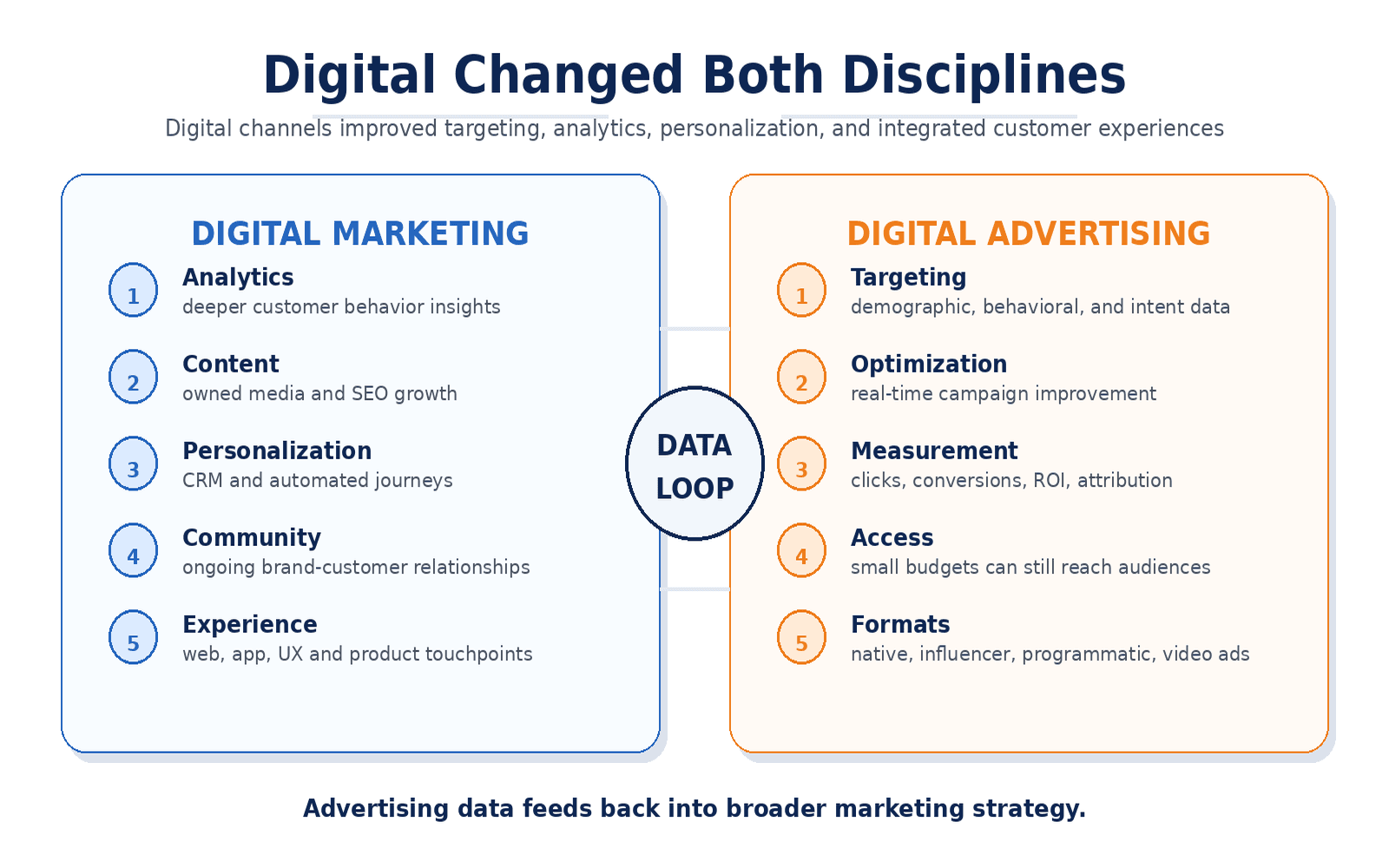
Digital transformation has impacted both disciplines significantly but hasn't erased their fundamental distinctions.
How Digital Changed Marketing:
Data-Driven Decision Making: Digital analytics provide unprecedented insights into customer behavior, campaign performance, and attribution across touchpoints.
Content Marketing Dominance: Owned media (blogs, podcasts, YouTube channels) allows businesses to reach audiences without traditional advertising costs.
Personalization at Scale: Marketing automation and CRM systems enable personalized communication with thousands or millions of individuals.
Community Building: Social media platforms facilitate direct, ongoing relationships between brands and customers.
Integrated Customer Experiences: Marketing now encompasses website UX, app functionality, and digital product experiences blurring lines between product and marketing.
How Digital Changed Advertising:
Precise Targeting: Digital advertising enables targeting based on demographics, behaviors, interests, and intent that traditional advertising couldn't match.
Real-Time Optimization: Campaigns adjust based on performance data in real-time rather than waiting for post-campaign reports.
Performance Measurement: Digital advertising provides granular metrics tracking impressions, clicks, conversions, and ROI with unprecedented precision.
Lower Barriers to Entry: Small businesses can run effective advertising campaigns with budgets that wouldn't cover single traditional media placements.
New Formats: Native advertising, influencer partnerships, programmatic advertising, and interactive ads create formats impossible in traditional media.
Despite these changes, the fundamental relationship remains advertising executes specific promotional tactics within comprehensive marketing strategies.
Building an Integrated Marketing and Advertising Strategy

The most effective business growth strategies integrate marketing and advertising strategically rather than treating them as alternatives.
Integration Framework:
Step 1 - Marketing Foundation:
Define target audiences through research
Develop unique value propositions
Establish brand positioning and messaging
Create content marketing foundation
Build owned media properties (website, blog, email list)
Step 2 - Organic Marketing Execution:
Implement SEO and content marketing
Build social media presence organically
Develop referral and partnership programs
Optimize customer experience and retention
Step 3 - Strategic Advertising Layer:
Identify high-value audience segments for paid targeting
Develop advertising creative aligned with marketing messages
Test advertising channels and campaigns systematically
Scale winning campaigns while maintaining marketing foundation
Step 4 - Continuous Optimization:
Analyze integrated performance across marketing and advertising
Feed advertising insights back into marketing strategy
Adjust budget allocation based on channel performance
Test new channels and tactics continuously
This integrated approach leverages marketing's comprehensive strategy while using advertising's scalability to accelerate growth.
Frequently Asked Questions
Is social media marketing or advertising? Both. Organic social media content (posts, engagement, community building) is marketing. Paid social media ads are advertising. Most businesses use social media for both marketing and advertising purposes.
Which is more important, marketing or advertising? Marketing is more fundamental it includes advertising plus strategy, research, product development, and customer relationships. However, advertising can be critical for accelerating growth when marketing foundation is strong.
Can you have advertising without marketing? Technically yes, but it's ineffective. Advertising without marketing strategy unclear targeting, inconsistent messaging, poor product-market fit wastes budget delivering the wrong message to the wrong people.
How much should businesses spend on advertising versus other marketing? Industry benchmarks vary widely, but advertising typically comprises 25-50% of total marketing budgets for growth-focused businesses. Early-stage companies might spend less on advertising (more on product and content), while mature companies in competitive markets might spend more.
Is public relations marketing or advertising? Public relations is marketing, not advertising. PR involves earned media (journalists choosing to cover your story) rather than paid placements, though the lines blur with sponsored content and paid influencer partnerships.
Do I need a separate marketing and advertising team? For small businesses, the same people often handle both. Larger organizations typically have marketing teams (strategy, product marketing, content) and advertising specialists (media buying, campaign management, creative production). The teams should collaborate closely.
Conclusion
Marketing and advertising represent distinct but complementary business disciplines. Marketing encompasses the comprehensive process of understanding customers, creating value, and building relationships. Advertising serves as one tactical tool within marketing specifically, paid communication designed to promote products and persuade audiences.
Successful businesses don't choose between marketing and advertising they integrate both strategically. Strong marketing provides the foundation: target audience understanding, value proposition clarity, brand positioning, and customer relationship strategies. Advertising amplifies this foundation through paid channels, accelerating reach and growth beyond what organic marketing alone achieves.
For small businesses and startups, prioritizing marketing foundation before significant advertising investments typically delivers better long-term results. Understanding your market, developing product-market fit, creating valuable content, and building organic audiences costs time more than money and creates sustainable competitive advantages.
As businesses grow and marketing foundations strengthen, strategic advertising investments accelerate growth, defend market position, and reach new audiences efficiently. The key is viewing advertising as amplification of strong marketing, not as a replacement for it.
Whether you're allocating budget, building teams, or developing strategy, understanding that advertising lives within marketing not separate from or equivalent to it enables better decision-making and more effective resource allocation. Both disciplines matter, but marketing provides the strategic foundation that makes advertising investment effective.
Timeframe
2022 - 2023
Client
Escoba Inc.