Push vs. Pull Marketing: The Ultimate Guide 2026 - Strategies That Drive Results
Push vs. Pull Marketing: The Ultimate Guide 2026 - Strategies That Drive Results
Introduction
Marketing strategies fundamentally divide into two approaches that represent opposite philosophies about how to reach customers and drive sales. Push marketing actively promotes products directly to consumers, while pull marketing creates demand that draws customers to products organically. Understanding the distinction between these approaches and when to use each is essential for effective marketing strategy.
Many marketers debate which approach is "better," but this misses the point. Both push and pull marketing have appropriate applications depending on product type, market maturity, customer journey stage, and business objectives. The most successful marketing strategies intelligently combine both approaches to maximize reach and conversion.
Primary Keyword: Push vs pull marketing Secondary Keywords: Push marketing strategy, pull marketing strategy, push and pull marketing, marketing strategies, inbound marketing, outbound marketing, demand generation Keyword Clusters:
Push Marketing (advertising, direct sales, promotions, trade shows)
Pull Marketing (content marketing, SEO, social media, branding)
Strategy Selection (when to use, benefits, drawbacks)
Integrated Approach (combining methods, omnichannel)
What is Push Marketing?
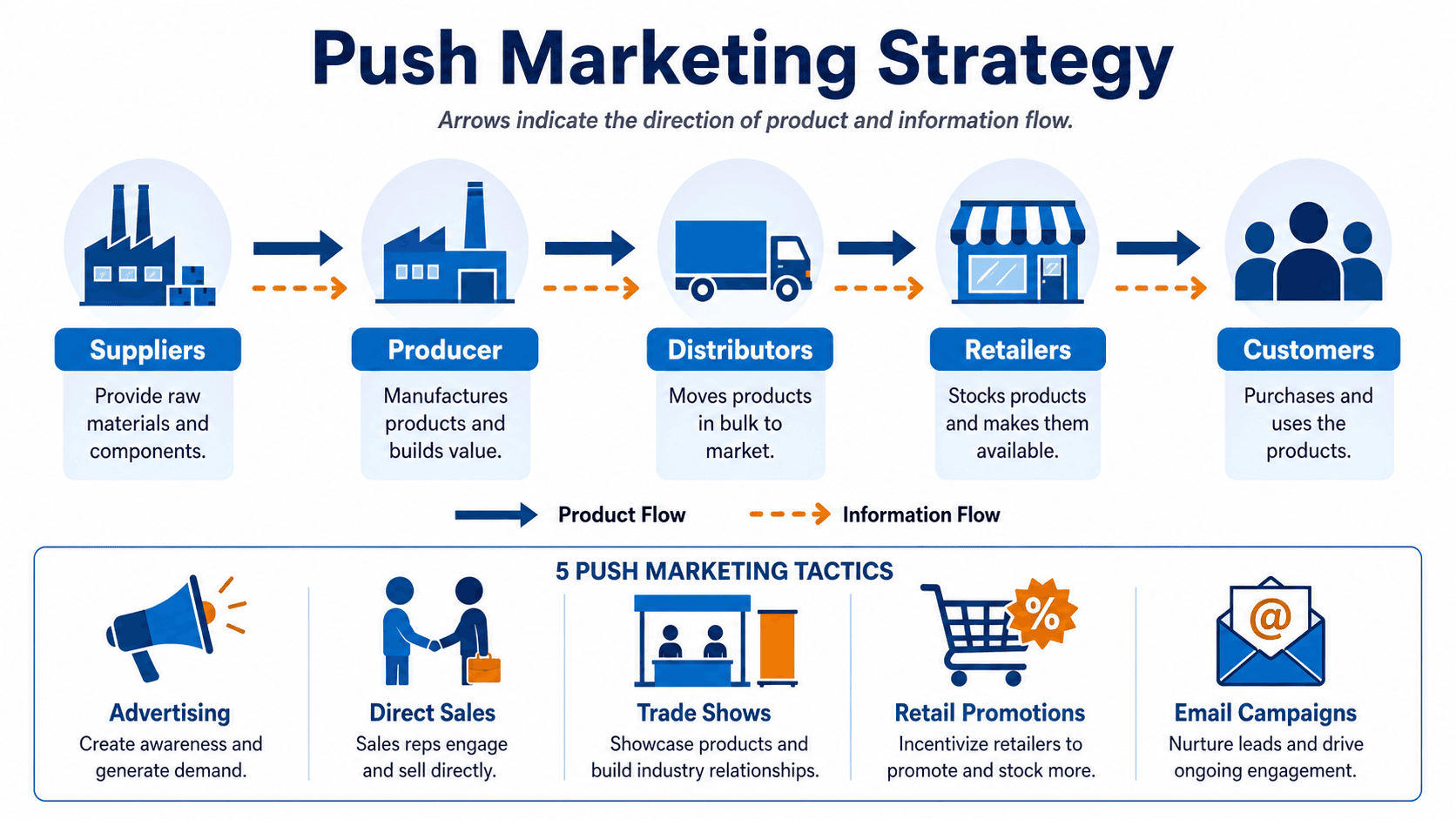
Push marketing involves proactively "pushing" products or messages to customers through interruptive channels, whether they've expressed interest or not.
Core Concept: The business pushes marketing messages through distribution channels to reach customers.
Common Push Marketing Tactics:
Television and radio advertising
Print ads (newspapers, magazines)
Direct mail campaigns
Cold calling and outbound sales
Trade shows and exhibitions
Email blasts (non-subscribed lists)
Display advertising
Retail promotions and point-of-sale displays
Door-to-door sales
Spam and unsolicited messaging
How It Works: Businesses identify target audiences and deploy marketing messages through various channels hoping to capture attention, create awareness, and stimulate immediate purchase.
Example: A new soft drink company pays for TV commercials, places products prominently in stores, and distributes coupons to drive trial purchases. Customers learn about the product through marketing initiatives, not active searching.
What is Pull Marketing?
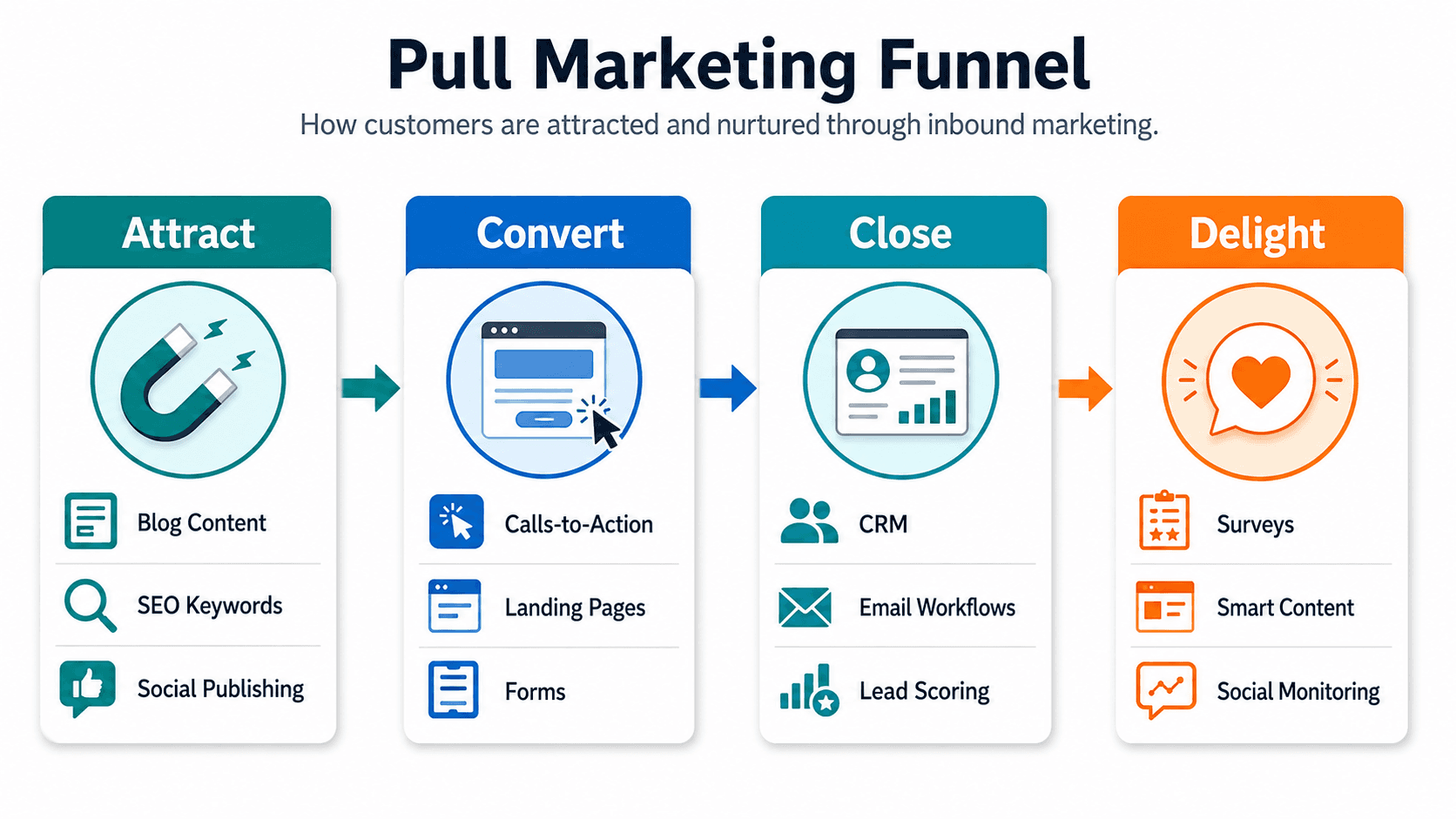
Pull marketing attracts customers by creating valuable content, building brand awareness, and optimizing discoverability so customers find and seek out products when they have needs.
Core Concept: Create demand that "pulls" customers toward your products through their active search and interest.
Common Pull Marketing Tactics:
Search engine optimization (SEO)
Content marketing (blogs, videos, podcasts)
Social media marketing (organic engagement)
Public relations and media coverage
Influencer marketing
Customer reviews and testimonials
Community building
Inbound marketing funnels
Brand building campaigns
Word-of-mouth marketing
How It Works: Businesses create valuable content, optimize for search, build brand recognition, and establish thought leadership so customers discover and choose their products when needs arise.
Example: A B2B software company publishes comprehensive guides about workflow automation, ranks highly in Google for related searches, builds reputation through case studies, and attracts customers actively researching solutions. Customers find the company through their own search.
Key Differences Between Push and Pull Marketing
Understanding the fundamental distinctions clarifies when each approach fits.
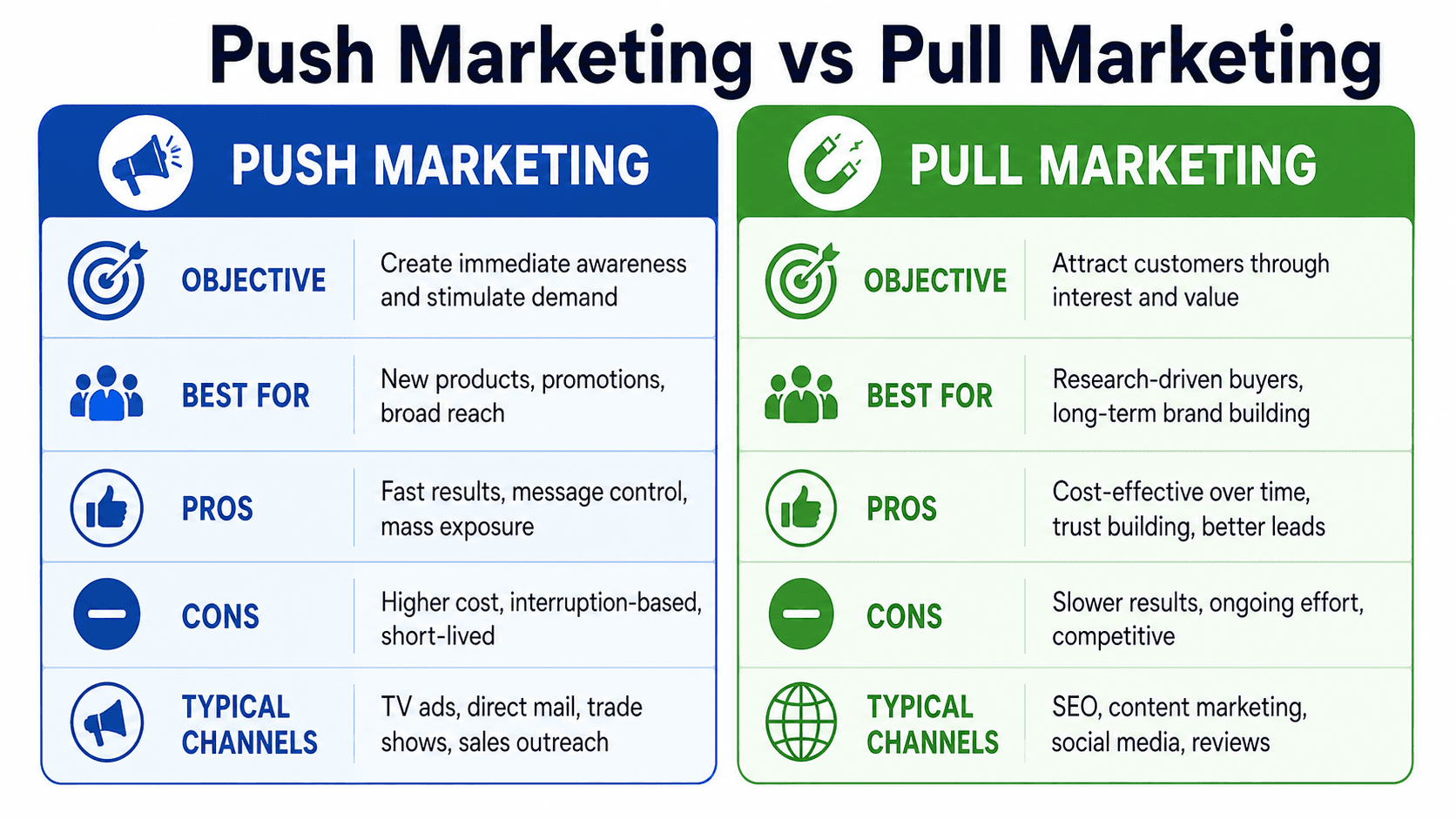
Customer Relationship:
Push: Interruption-based. Reaches customers whether they're interested or not. Pull: Permission-based. Customers choose to engage based on interest.
Communication Direction:
Push: One-way broadcast from business to customer. Pull: Two-way conversation with engaged audience.
Timeline:
Push: Short-term focus on immediate sales and conversions. Pull: Long-term focus on relationship building and sustained demand.
Cost Structure:
Push: High upfront costs for media buys and promotions. Costs end when campaigns stop. Pull: Lower initial costs but requires sustained investment. Creates compounding value over time.
Measurement:
Push: Direct attribution track responses to specific campaigns. Pull: Indirect attribution difficult to attribute specific conversions to specific content.
Customer Stage:
Push: Targets customers not actively searching (top of funnel). Pull: Attracts customers actively searching for solutions (mid to bottom funnel).
Scalability:
Push: Scales with budget more spend equals more reach. Pull: Scales with effort and quality better content equals compounding organic reach.
Examples:
Push: Super Bowl commercial costing $7M reaching 100M viewers
Pull: Viral blog post costing $500 to create generating 5M views over 3 years
Advantages and Disadvantages of Push Marketing
Advantages:
Immediate Results: Push marketing generates quick awareness and sales. Launch a campaign today, see results tomorrow.
Broad Reach: Mass media campaigns reach millions quickly, building awareness at scale.
Control: Complete control over messaging, timing, and targeting.
Suitable for New Products: Customers can't search for products they don't know exist. Push marketing creates initial awareness.
Predictable Outcomes: Established channels provide predictable reach and response rates enabling forecasting.
Competitive Advantage: Can disrupt competitors by reaching their customers with aggressive promotion.
Disadvantages:
High Costs: Media buying, production, and distribution require significant investment.
Short-Lived: Effects diminish immediately when campaigns end. No compounding value.
Decreasing Effectiveness: Ad blocking, cord-cutting, and advertising fatigue reduce push marketing impact.
Customer Resistance: Interruptive messaging annoys customers and damages brand perception.
Poor Targeting: Broad reach means wasting impressions on non-prospects.
Difficult Attribution: Hard to measure true ROI when customers see multiple messages across channels.
Advantages and Disadvantages of Pull Marketing
Advantages:
Cost-Effective Long-Term: Content and SEO create compounding value. A blog post continues attracting traffic years after publication.
Higher Quality Leads: Customers finding you through search have demonstrated intent, converting at higher rates.
Builds Authority: Valuable content establishes thought leadership and trust.
Sustainable: Pull marketing creates assets (content, rankings, brand equity) that persist.
Customer Preference: People prefer researching independently to being sold to.
Compound Growth: Successful content attracts links, improving rankings, attracting more traffic in virtuous cycle.
Disadvantages:
Slow to Build: Pull strategies require months to years showing significant results.
Requires Consistent Effort: Content creation, community engagement, and SEO demand ongoing resources.
Difficult to Attribute: Hard to connect specific content to specific conversions in multi-touch journeys.
Competitive: Ranking requires out-competing others for attention and search visibility.
Expertise Required: Creating valuable content demands subject matter expertise and communication skills.
Uncertain Outcomes: Unlike paid media with predictable reach, pull marketing success varies dramatically.
When to Use Push Marketing
Push marketing fits specific business situations and objectives.
Launching New Products:
Customers can't search for products they don't know exist. Push marketing creates initial awareness enabling subsequent pull marketing.
Time-Sensitive Offers:
Limited-time sales, seasonal promotions, and event-based marketing require reaching customers quickly before opportunities expire.
Saturated Markets:
When competitors dominate search and content, paid promotion may be the only way to reach customers.
Low Customer Awareness:
In early markets where customers don't recognize their problems or know solutions exist, education through push channels works.
B2C Impulse Purchases:
Consumer products with short consideration cycles (snacks, beverages, small purchases) benefit from awareness-driving push marketing.
Retail Distribution:
Physical products need retail placement. Trade promotions and retailer incentives (push to trade) ensure distribution.
Rapid Scaling:
When growth targets require quick customer acquisition, push marketing provides speed pull strategies can't match.
When to Use Pull Marketing
Pull marketing excels in different scenarios:
High Consideration Purchases:
Complex B2B solutions, expensive consumer products, and services requiring research benefit from pull strategies attracting qualified buyers.
Building Long-Term Brand:
Pull marketing creates sustainable brand equity and thought leadership that persists beyond individual campaigns.
Content-Ready Industries:
Professional services, education, healthcare, and technology lend themselves to valuable content creation.
SEO-Friendly Products:
Products people actively search for ("accounting software," "gym near me," "best laptops 2026") benefit from search optimization.
Community-Driven Categories:
Hobbies, interests, and lifestyle products with engaged communities benefit from pull marketing building those communities.
Limited Marketing Budgets:
Startups and small businesses often achieve better ROI from pull marketing's lower initial costs and compounding returns.
Building Customer Relationships:
Subscription businesses and services requiring ongoing relationships benefit from pull marketing's relationship focus.
Combining Push and Pull: Integrated Marketing
The most effective strategies combine both approaches strategically.
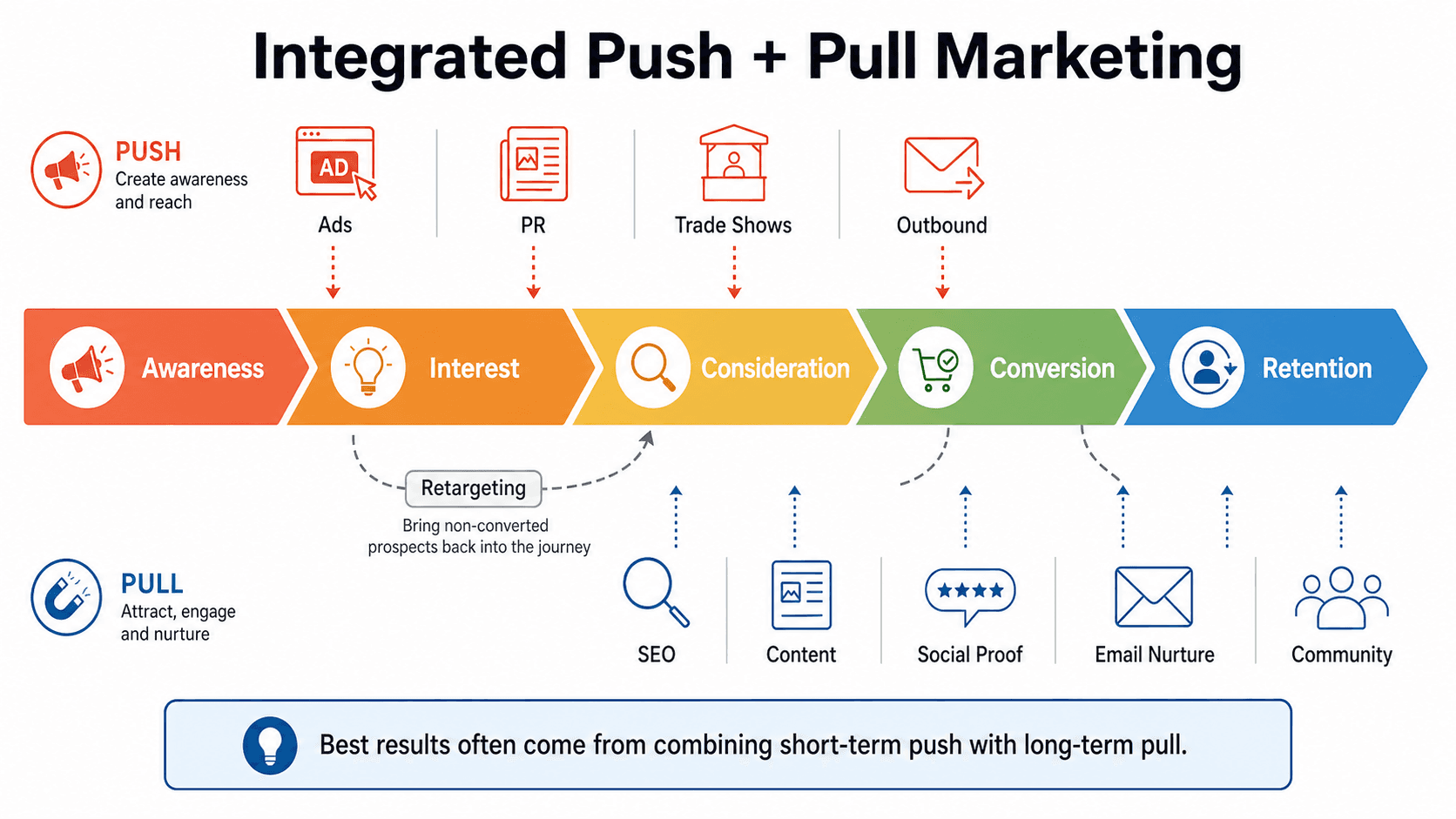
Sequential Strategy:
Use push marketing to launch products and create initial awareness, then sustain momentum with pull marketing for ongoing demand generation.
Example: Software company launches with paid advertising and PR (push) to create awareness, then invests in content marketing and SEO (pull) for sustainable lead generation.
Funnel Alignment:
Use push marketing for top-of-funnel awareness and pull marketing for mid and bottom-funnel conversion.
Example: Consumer brand runs TV advertising (push) for broad awareness while maintaining content and SEO (pull) for customers actively researching purchases.
Channel Mix:
Allocate budget across push and pull channels based on ROI and strategic objectives.
Example: B2B company uses 30% budget for trade shows and outbound sales (push) and 70% for content marketing and inbound (pull).
Reinforcement:
Use pull marketing to strengthen credibility of push marketing messages.
Example: Customers see display ads (push), search brand name, find authoritative content (pull), and convert with confidence.
Remarketing Bridge:
Use push marketing (retargeting ads) to re-engage customers who discovered you through pull marketing but didn't convert.
Push and Pull Marketing in Different Industries
B2B Technology:
Pull Dominant: Content marketing, SEO, thought leadership, webinars, whitepapers. Long sales cycles favor pull. Push Support: Trade shows, LinkedIn ads, outbound sales for enterprise accounts.
Consumer Packaged Goods:
Push Dominant: TV advertising, retail promotions, influencer sponsorships. Awareness drives impulse purchases. Pull Support: Recipe content, social media engagement, SEO for branded searches.
Professional Services:
Pull Dominant: Content demonstrating expertise, SEO, speaking engagements, published research. Push Support: Networking events, targeted email campaigns to prospects.
E-Commerce Fashion:
Balanced: Social media advertising and influencer partnerships (push) combined with content, SEO, and social engagement (pull).
Real Estate:
Push Dominant: Direct mail, cold outreach, yard signs, newspaper ads for immediate attention. Pull Support: Website SEO, neighborhood guides, market insights content.
The Future of Push vs. Pull Marketing
Trends Favoring Pull Marketing:
Ad blocking and subscription streaming reduce push marketing reach
Consumer preference for research over interruption
Google and SEO driving purchase decisions
Privacy regulations limiting targeting capabilities
Declining trust in traditional advertising
Trends Sustaining Push Marketing:
New channels emerging (TikTok ads, streaming audio ads, podcast sponsorships)
Better targeting through first-party data
Event-based and contextual advertising improving relevance
Retail media networks providing point-of-purchase push opportunities
Convergence:
The lines blur as pull channels add paid promotion options (promoted posts, sponsored content) and push channels incorporate content elements (native advertising, branded content).
Frequently Asked Questions
Is digital marketing push or pull? Both. Paid social media ads, display advertising, and email to purchased lists are push. SEO, content marketing, and organic social media are pull. Most digital strategies combine both.
Which is more effective, push or pull marketing? Neither is universally better. Push marketing drives faster results and broader reach. Pull marketing delivers better long-term ROI and higher-quality leads. Effectiveness depends on business objectives, product type, market maturity, and budget.
Can small businesses afford pull marketing? Yes. Pull marketing often suits small businesses better due to lower initial costs. Content creation, SEO, and social media require time and skill more than money, making them accessible to resource-constrained businesses.
How long does pull marketing take to work? Typically 3-6 months to see initial traction, 6-12 months for meaningful results, 12-24 months for mature programs. SEO particularly requires patience. Push marketing delivers immediate but short-lived results.
Should I choose push or pull for my business? Use both. Most successful businesses employ integrated strategies using push marketing for awareness and urgency, pull marketing for sustainable lead generation and brand building. Adjust the mix based on your specific situation.
Is inbound marketing the same as pull marketing? Essentially yes. Inbound marketing is a specific pull marketing methodology focused on attracting customers through valuable content and optimized experiences rather than interruption.
Conclusion
Push and pull marketing represent fundamentally different approaches to reaching customers. Push marketing proactively delivers messages to broad audiences through interruptive channels, driving immediate awareness and sales. Pull marketing creates valuable content and optimizes discoverability, attracting customers actively searching for solutions.
Neither approach is inherently superior. Push marketing excels at rapid awareness building, new product launches, and time-sensitive promotions. Pull marketing delivers sustainable lead generation, builds thought leadership, and creates compounding value over time.
The most effective marketing strategies intelligently combine both approaches based on business objectives, product characteristics, customer journey stage, and available resources. Use push marketing to create awareness and urgency. Use pull marketing to build relationships and sustainable demand.
As markets evolve, consumer preferences shift toward pull marketing researching independently, blocking ads, and trusting content over commercials. However, push marketing adapts through new channels, better targeting, and integration with content.
Evaluate your current marketing mix. Are you over-invested in short-term push tactics at the expense of long-term pull strategies? Or are you waiting for pull marketing to mature while competitors capture market share through aggressive push? The optimal balance creates immediate results while building sustainable competitive advantages.
Begin by auditing current efforts across the push-pull spectrum. Identify gaps where customer journey stages lack appropriate marketing support. Test integrated campaigns combining push awareness-building with pull lead nurturing. Measure both short-term conversion (push strength) and long-term asset value creation (pull strength).
Marketing success in 2026 belongs to those who master both push and pull, deploying each strategically based on objectives rather than ideology, and building integrated systems that maximize both immediate results and sustained growth.
Timeframe
2022 - 2023
Client
Escoba Inc.