Revenue Management Software: Maximizing Pricing and Profitability in 2026
Revenue Management Software: Maximizing Pricing and Profitability in 2026
Introduction
Revenue management software uses data analytics and algorithms to optimize pricing, inventory, and distribution strategies, maximizing revenue from available capacity. Originally developed for airlines, these systems now serve hotels, car rentals, events, SaaS companies, and any business with variable demand and limited inventory.
This guide explains what revenue management software does, how it works, types available, key features, industry applications, and selection criteria.
Primary Keyword: Revenue management software Secondary Keywords: Revenue optimization software, dynamic pricing software, yield management, pricing software Keyword Clusters: Software features, industry applications, pricing strategies, implementation

What is Revenue Management Software?
Revenue management software analyzes demand patterns, competitor pricing, and market conditions to recommend optimal pricing maximizing revenue and profitability. These systems use algorithms predicting demand, adjusting prices dynamically, and managing inventory allocation across channels.
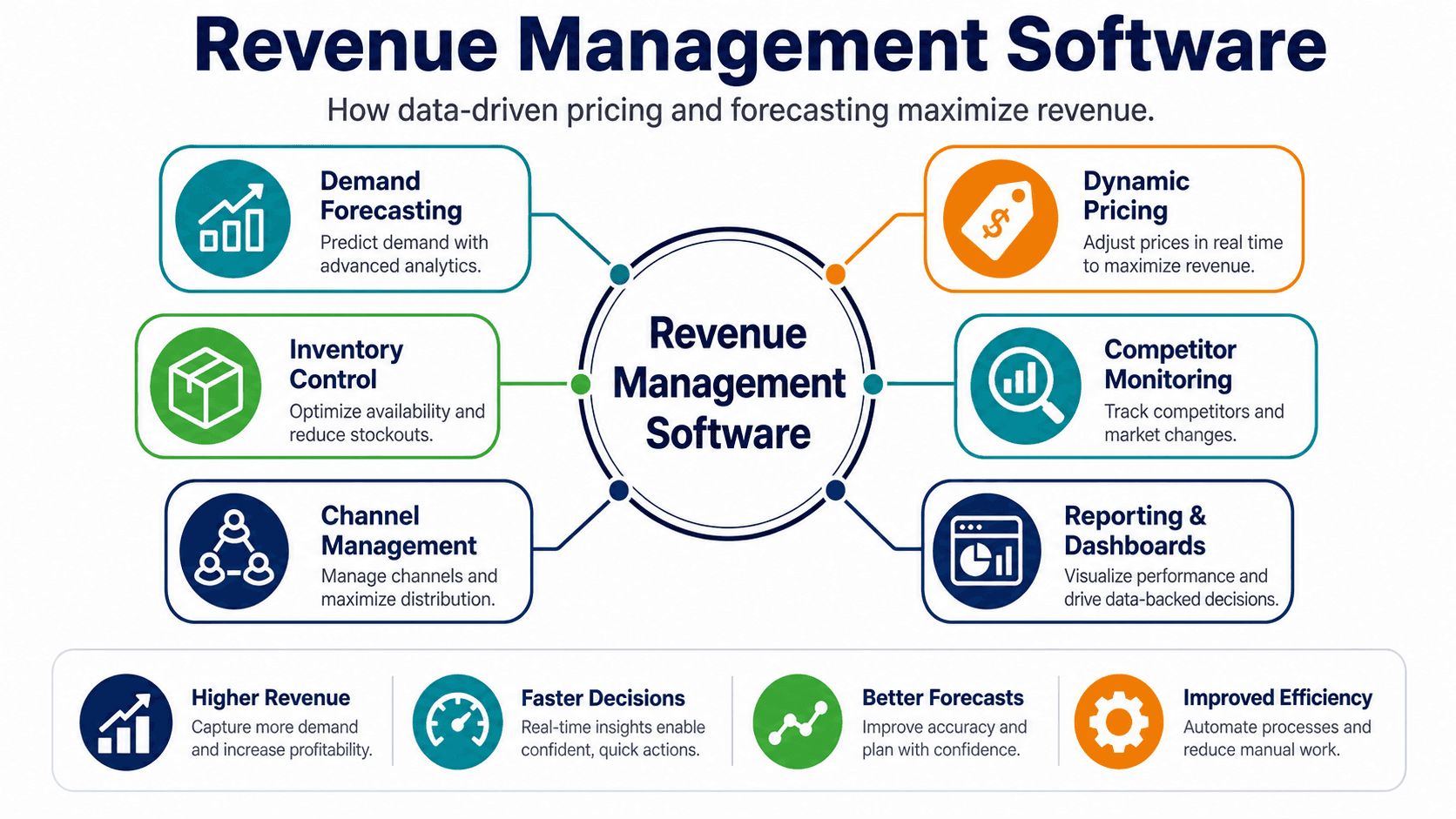
Core Functions: Demand forecasting, dynamic pricing, inventory management, competitor analysis, channel optimization, performance analytics
Goal: Sell the right product to the right customer at the right time for the right price through the right channel
How Revenue Management Software Works
Data Collection
Historical sales data, booking patterns, competitor prices, market conditions, seasonal trends, customer behavior, external factors (events, weather)
Demand Forecasting
Machine learning algorithms analyze patterns, predict future demand by segment, identify high/low demand periods, forecast booking curves, adjust for market changes
Price Optimization
Calculate optimal price points, set price floors and ceilings, implement dynamic pricing rules, segment-based pricing, real-time adjustments
Inventory Control
Allocate inventory across channels, set booking restrictions, manage overbooking strategies, optimize availability, control distribution
Performance Monitoring
Track actual vs. predicted, measure revenue lift, analyze conversion rates, identify optimization opportunities, generate insights
Key Features
Dynamic Pricing
Automatic price adjustments based on demand, competitor-responsive pricing, time-based pricing rules, customer segment differentiation, channel-specific pricing
Forecasting Analytics
Demand prediction models, booking pace analysis, market trend identification, seasonal pattern recognition, event impact assessment
Competitor Monitoring
Real-time competitor pricing tracking, market positioning analysis, rate parity monitoring, competitive benchmarking, automated alerting
Channel Management
Multi-channel distribution, channel performance tracking, rate parity enforcement, commission optimization, OTA management
Reporting and Dashboards
Real-time performance metrics, revenue reports, pickup reports, forecast accuracy, market share analysis, customizable dashboards
Rules Engine
Business rule configuration, override capabilities, approval workflows, pricing constraints, strategic controls
Industry Applications
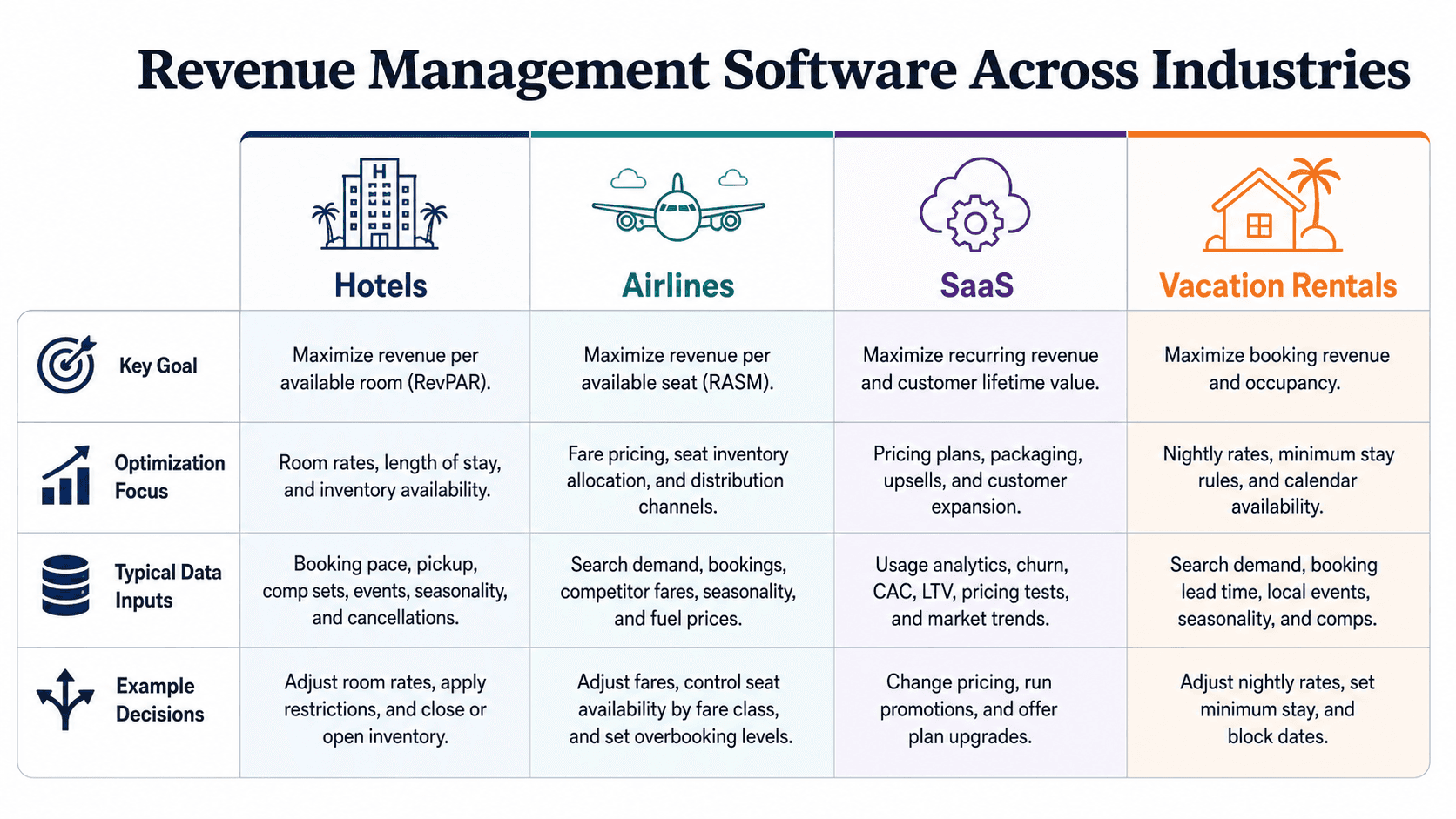
Hospitality (Hotels, Resorts)
Room pricing optimization, length-of-stay controls, group booking management, package pricing, seasonal strategies
Leading Vendors: IDeaS, Duetto, Rainmaker, Atomize
Airlines
Seat pricing and inventory, fare class management, route optimization, ancillary revenue, overbooking management
Leading Vendors: Amadeus, Sabre, PROS
Car Rental
Fleet pricing, duration-based rates, location pricing, age-based segmentation, ancillary optimization
Leading Vendors: Infor, IDeaS, Revenue Analytics
Events and Entertainment
Ticket pricing tiers, dynamic event pricing, resale market optimization, VIP packages, capacity optimization
Leading Vendors: Digonex, KORE Software, Paciolan
SaaS and Software
Subscription pricing optimization, feature-based pricing, usage-based billing, discount management, expansion revenue
Leading Vendors: ProfitWell, Paddle, Chargebee
Vacation Rentals
Property pricing, seasonal adjustments, minimum stay rules, dynamic discounts, competitive positioning
Leading Vendors: Beyond Pricing, Wheelhouse, PriceLabs
Benefits of Revenue Management Software
Revenue Increase
3-8% revenue lift typical for hotels, 5-15% for airlines, improved yield per unit, optimized mix of business
Operational Efficiency
Automated pricing decisions, reduced manual work, faster market response, consistent strategy execution
Competitive Advantage
Data-driven decisions, market responsiveness, strategic positioning, superior forecasting
Better Insights
Demand pattern understanding, customer behavior analysis, market trend identification, performance attribution
Risk Mitigation
Demand fluctuation management, revenue protection, overbooking optimization, market volatility response
Selecting the Right Software
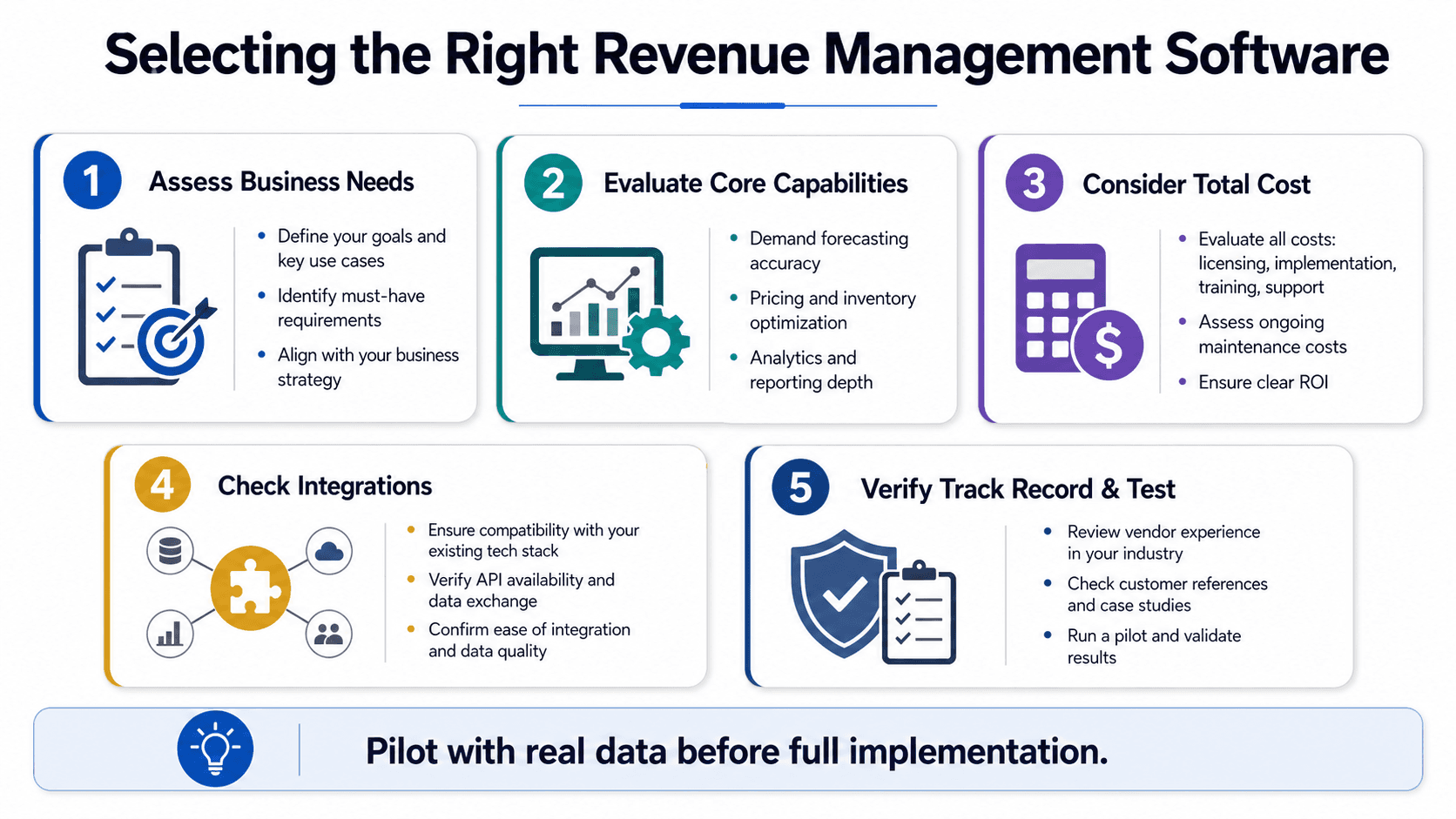
Assess Business Needs
Industry requirements, complexity of inventory, number of price points, channel ecosystem, integration needs, team capabilities
Evaluate Core Capabilities
Forecasting accuracy, pricing optimization sophistication, ease of use, implementation time, support quality, scalability
Consider Total Cost
Licensing fees (often revenue %), implementation costs, training requirements, ongoing support, integration development
Check Integration
PMS/reservation systems, POS systems, accounting software, distribution channels, marketing platforms, business intelligence
Verify Track Record
Industry experience, client references, case studies, vendor stability, innovation roadmap, support reputation
Test Before Committing
Request demos with your data, pilot programs, trial periods, sandbox environments, implementation planning
Implementation Best Practices
Preparation Phase
Clean historical data, document current processes, define success metrics, secure executive buy-in, allocate resources
Configuration Phase
Set business rules, establish price floors/ceilings, configure segments, integrate systems, customize reports
Testing Phase
Validate forecasts against actuals, test pricing scenarios, verify integrations, ensure data accuracy, train team
Go-Live Phase
Monitor closely initially, start with conservative rules, gradually increase automation, gather feedback, optimize configurations
Optimization Phase
Review performance regularly, refine algorithms, adjust rules, expand capabilities, measure ROI
Common Challenges
Data Quality Issues
Solution: Data cleaning process, ongoing maintenance, automated validation, clear data standards
User Resistance
Solution: Change management, demonstrate value, involve stakeholders early, training programs, gradual adoption
Over-Automation
Solution: Maintain human oversight, approval workflows for significant changes, override capabilities, strategic controls
Integration Complexity
Solution: Prioritize critical integrations, use experienced partners, allocate adequate time, test thoroughly
Unrealistic Expectations
Solution: Clear communication of timelines, phased approach, celebrate quick wins, realistic ROI projections
Measuring Success
Revenue Metrics
Total revenue growth, RevPAR (revenue per available room), yield improvement, average price increase, market share gains
Operational Metrics
Forecast accuracy, pricing decisions automated, time saved, system adoption rate, override frequency
Financial Metrics
ROI achievement, incremental revenue, margin improvement, total profitability, cost savings
Typical ROI Timeline
Hotels: 3-9 months, Airlines: 12-18 months, SaaS: 6-12 months, varies by industry and implementation quality
Frequently Asked Questions
How much does revenue management software cost? Varies widely by industry and company size. Hotels: $500-$5,000+ monthly. SaaS: Often percentage of revenue (0.5-2%). Airlines: Enterprise pricing. Many use revenue-based pricing models.
Will software replace revenue managers? No software augments, not replaces. Human strategic oversight, market understanding, and business judgment remain essential. Software handles analytical heavy lifting, freeing revenue managers for strategy.
How long until we see results? Quick wins possible within weeks. Meaningful results typically 3-6 months. Full optimization 6-12 months as system learns patterns and team gains confidence.
Can small businesses use revenue management software? Yes. Cloud-based solutions now serve businesses of all sizes. Entry-level options exist for small hotels, vacation rentals, and service businesses starting under $100/month.
What data is needed for revenue management software? Minimum: historical sales/booking data, pricing history, availability/capacity. Optimal: competitor data, market data, customer segments, external factors, channel performance.
How accurate are demand forecasts? Modern systems achieve 85-95% accuracy for near-term forecasts. Accuracy decreases for longer horizons and during unprecedented events. Continuous learning improves predictions over time.
Conclusion
Revenue management software transforms pricing from gut feel to data-driven science, optimizing revenue through demand forecasting, dynamic pricing, and inventory management. Industries with perishable inventory, variable demand, and segmented customers benefit most from these systems.
Selecting appropriate software requires understanding your business complexity, evaluating vendor capabilities, considering total costs, and planning implementation carefully. Success depends equally on software sophistication and user adoption technology enables better decisions but doesn't eliminate need for strategic thinking.
Implementation takes time and commitment but delivers significant returns through revenue increases, operational efficiency, competitive advantages, and strategic insights. Start with clear objectives, clean data, realistic expectations, and strong change management.
The businesses winning in dynamic markets are those leveraging data and algorithms to respond faster, price smarter, and optimize more effectively than competitors still using static pricing and gut instinct. Revenue management software provides the capabilities making this possible.
Begin by assessing whether your business characteristics justify revenue management investment. Research industry-specific solutions. Evaluate vendors thoroughly with real data. Implement methodically with adequate training and change management. Measure results and optimize continuously. The revenue lift and competitive advantage make the investment worthwhile for businesses with the right characteristics and commitment to data-driven decision making.
Timeframe
2022 - 2023
Client
Escoba Inc.