Sales Follow Up Email Templates to Increase Conversions in 2026

Most sales are made after multiple follow-ups, yet 44% of salespeople give up after one attempt. Effective follow-up separates top performers from average reps, but knowing what to say, when to reach out, and how often requires strategy and proven templates.

This guide provides battle-tested sales follow-up email templates for every scenario, timing recommendations, customization tips, and best practices turning prospects into customers.
Primary Keyword: Sales follow up templates
Secondary Keywords: Follow up email templates, sales email templates, follow up strategies, email templates sales
Keyword Clusters: Template types, timing strategies, customization, best practices
Why Follow-Up Matters
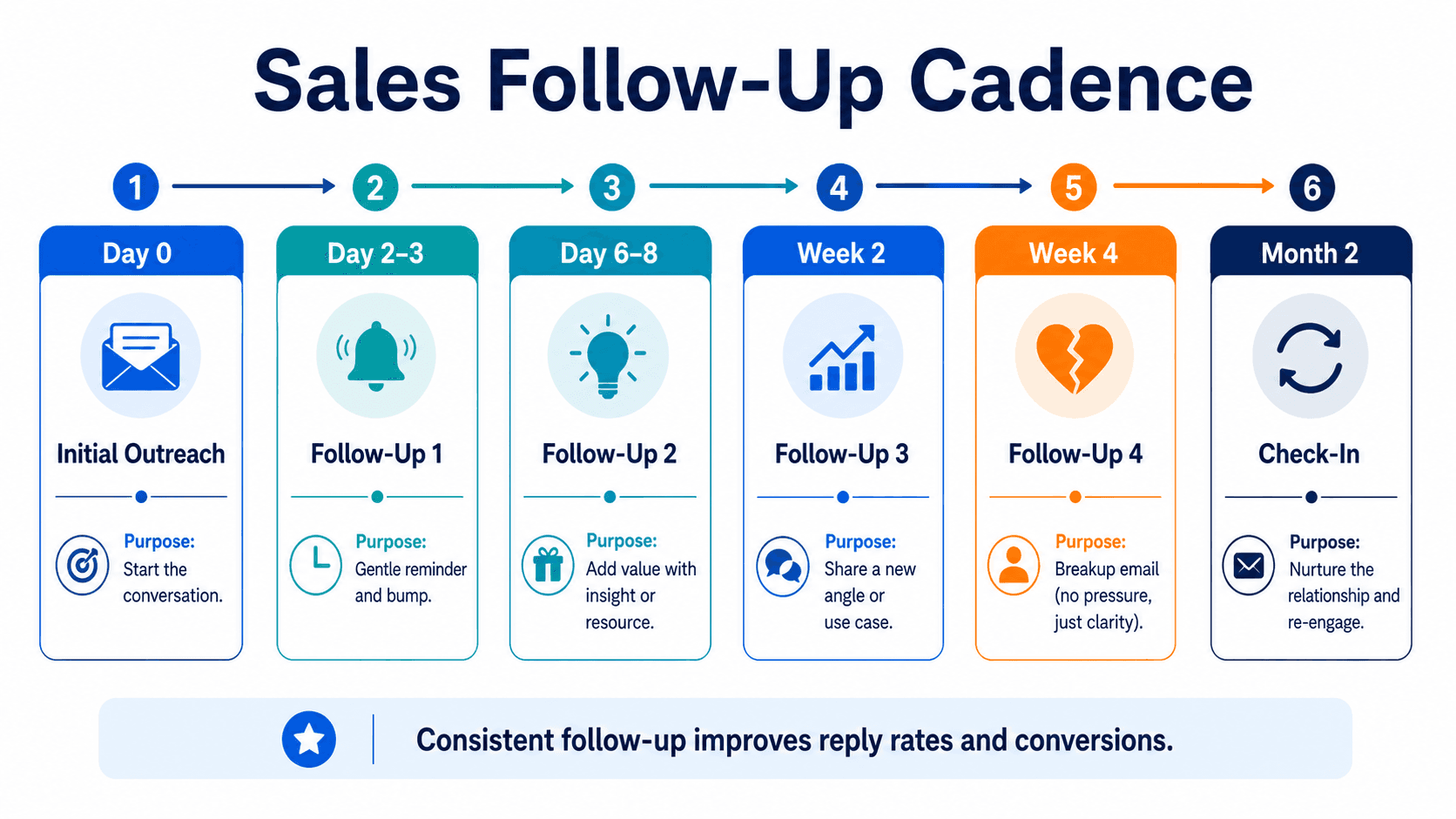
80% of sales require 5+ follow-ups yet most reps quit after 2-3 attempts, leaving massive revenue on the table.
Reasons Prospects Don't Respond Initially: Busy schedules, email overload, poor timing, not priority yet, forgot to respond, need more information
Follow-up demonstrates: Persistence without pressure, genuine interest in helping, professional consistency, reminder of value proposition
Follow-Up Email Best Practices
Timing Strategy
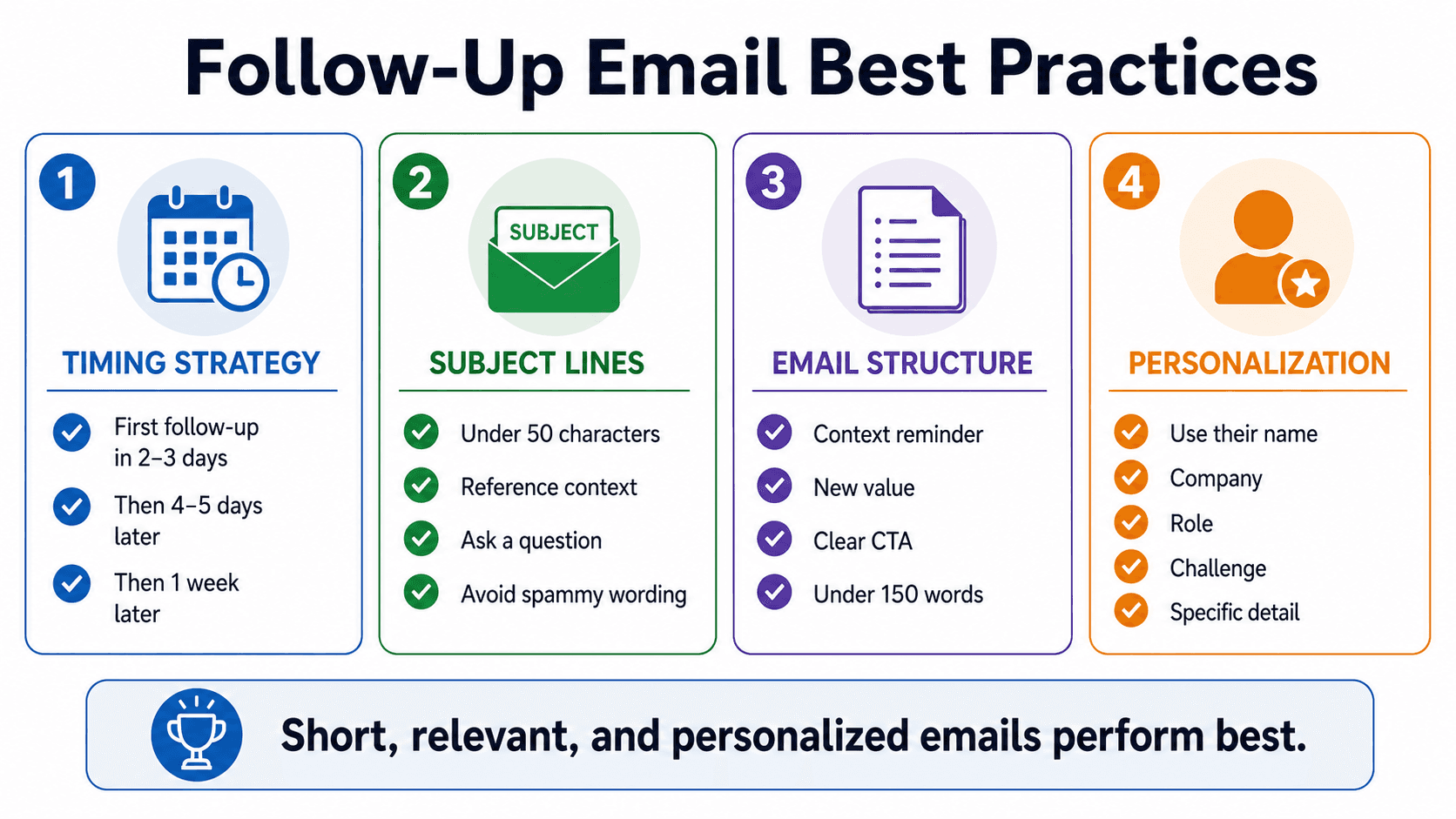
First follow-up: 2-3 days after initial contact Second: 4-5 days later Third: 1 week later Fourth: 2 weeks later Fifth+: Monthly check-ins
Subject Line Rules
Keep under 50 characters, reference previous conversation, ask questions, create curiosity, avoid spam triggers, A/B test variations
Email Structure
Open with context reminder (50 words max), provide new value or angle, include clear call-to-action, keep total under 150 words, mobile-optimized formatting
Personalization Requirements
Use prospect's name, reference their company/industry, mention specific pain points, cite previous conversation details, avoid obviously templated language
Template 1: Initial Follow-Up After No Response
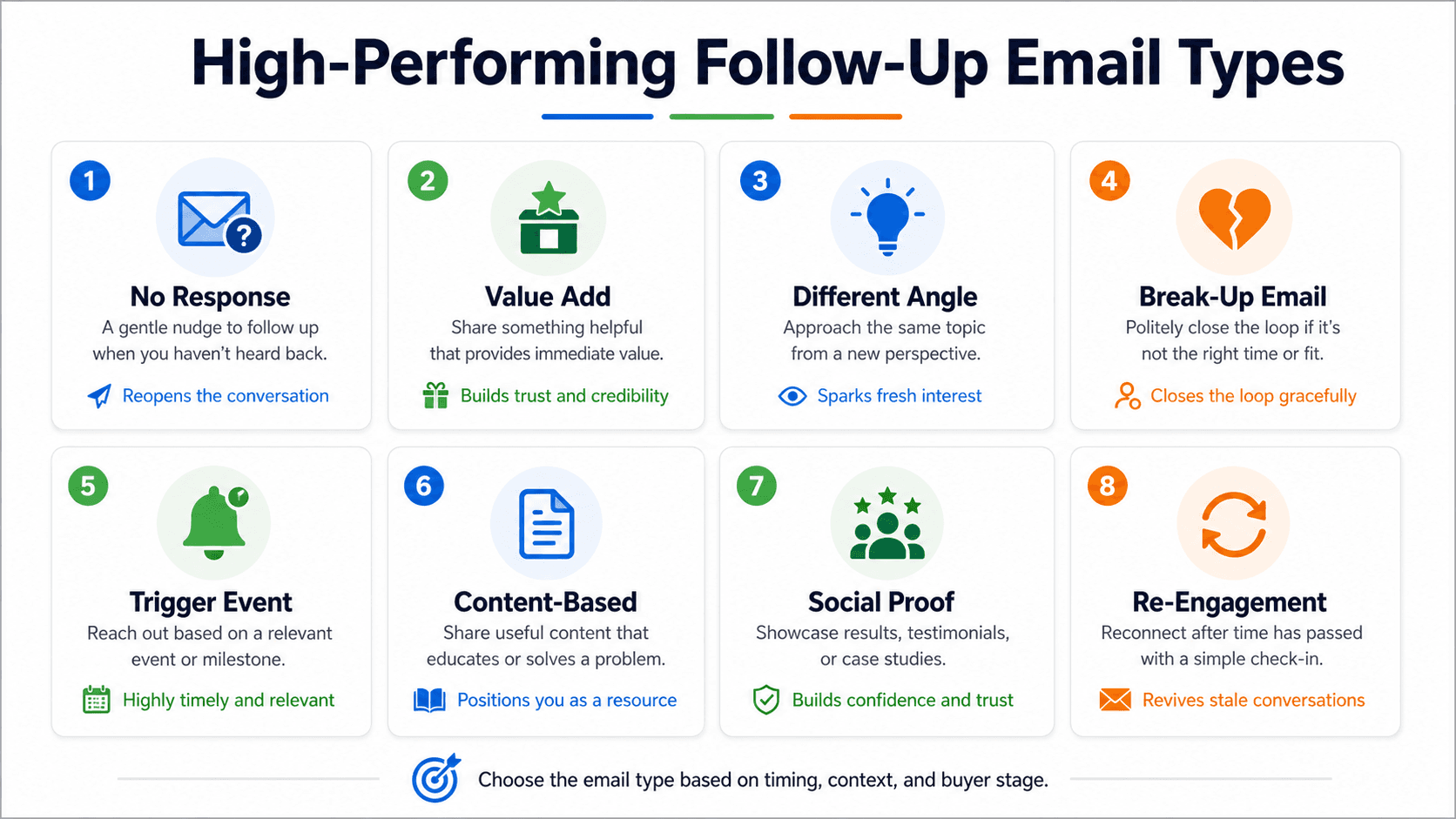
Subject: Quick follow-up - [Their Company]
Hi [Name],
I reached out last week about [specific value proposition]. I know inboxes get overwhelming, so I wanted to make sure this didn't get lost.
[One sentence about their specific challenge or goal].
Would a quick 15-minute call this week make sense to explore whether [solution] could help?
[Your Name]
When to Use: 2-3 days after initial outreach with no response Why It Works: Acknowledges busy schedules, provides context, low-pressure
Template 2: Value-Add Follow-Up
Subject: Thought this might help - [Relevant Topic]
Hi [Name],
I was researching [their industry/challenge] and came across [article/study/resource] that reminded me of our conversation about [specific topic].
[Link or 2-sentence summary of resource value]
Given [their specific situation], thought you might find this useful.
Still interested in discussing how [solution] addresses [specific challenge]?
[Your Name]
When to Use: After 1st follow-up, providing genuinely helpful content Why It Works: Leads with value, not sales pitch; shows you're thinking about their needs
Template 3: Different Angle Follow-Up
Subject: Different thought on [Challenge]
Hi [Name],
I've been thinking about [their challenge] since we last connected.
Beyond [original value prop], another way [solution] helps companies like [Their Company] is [different benefit/use case with specific example].
[Competitor/Similar Company] saw [specific result] using this approach.
Worth a quick conversation to see if this applies to your situation?
[Your Name]
When to Use: 3rd-4th touch, introducing new angle or benefit Why It Works: Fresh perspective maintains interest, shows deep understanding
Template 4: Break-Up Email
Subject: Should I close your file?
Hi [Name],
I've reached out a few times about [solution] but haven't heard back—totally understand if timing isn't right or priorities have shifted.
I'll assume you're all set and close out your file unless I hear otherwise.
If circumstances change and [specific challenge] becomes a priority, feel free to reach out.
Best, [Your Name]
When to Use: Final attempt after 4-5 unanswered touches Why It Works: Creates urgency through loss aversion, often generates response
Template 5: Event/Trigger-Based Follow-Up
Subject: Congrats on [Company News]
Hi [Name],
Just saw [Company] announced [funding/product launch/expansion/hire]. Congratulations!
This likely means [logical implication related to your solution]. We've helped similar companies navigate [related challenge] during growth phases.
[Specific example/case study].
Would a brief call make sense as you scale [relevant area]?
[Your Name]
When to Use: When prospect company has news, funding, launches Why It Works: Timely and relevant, shows you're paying attention
Template 6: Content-Based Follow-Up
Subject: [Engaging Question About Their Challenge]?
Hi [Name],
Quick question: [Specific, thoughtful question about their business/challenge]?
I ask because [explain why you're curious, connect to solution].
If you're facing [challenge], I'd love to share how [specific approach] has worked for [similar companies].
15 minutes this week?
[Your Name]
When to Use: Mid-sequence, opening with engagement Why It Works: Questions increase response rates, shows consultative approach
Template 7: Social Proof Follow-Up
Subject: How [Similar Company] solved [Challenge]
Hi [Name],
[Similar Company in their industry] had a similar challenge with [specific issue] last year.
They used [your solution/approach] and achieved [specific, impressive result].
Given the similarities I see with [Their Company], thought their approach might be relevant for you.
Worth discussing?
[Your Name]
When to Use: When you have strong case study match Why It Works: Proof reduces risk, shows understanding of their context
Template 8: Re-Engagement After Long Silence
Subject: Checking in - [Their Company]
Hi [Name],
It's been a while since we last connected about [topic]. A lot has probably changed since then.
We've rolled out [new feature/capability] that specifically addresses [challenge they mentioned].
[Brief 1-2 sentence description of value].
Curious if [their priority/challenge] is still on your radar?
[Your Name]
When to Use: 3-6 months after conversation went cold Why It Works: Acknowledges time passed, offers new reason to engage
Template 9: Referral Request Follow-Up
Subject: Quick favor?
Hi [Name],
I understand [solution] may not be right fit for [Their Company] right now—totally fine!
Since you understand the value, would you be open to introducing me to someone else who might benefit? Thinking particularly about [type of company/role].
I'd really appreciate it.
Thanks, [Your Name]
When to Use: When clear they won't buy but relationship is positive Why It Works: Turns "no" into potential new opportunity
Template 10: Meeting Reminder Follow-Up
Subject: Tomorrow at [Time] - [Topic]
Hi [Name],
Looking forward to our call tomorrow at [Time] to discuss [specific agenda].
To make best use of our time, I'll plan to cover: • [Key topic 1] • [Key topic 2] • [Key topic 3]
Anything else you'd like to make sure we address?
See you tomorrow, [Your Name]
When to Use: Day before scheduled meeting Why It Works: Reduces no-shows, sets expectations, shows preparation
Customization Best Practices
Research First
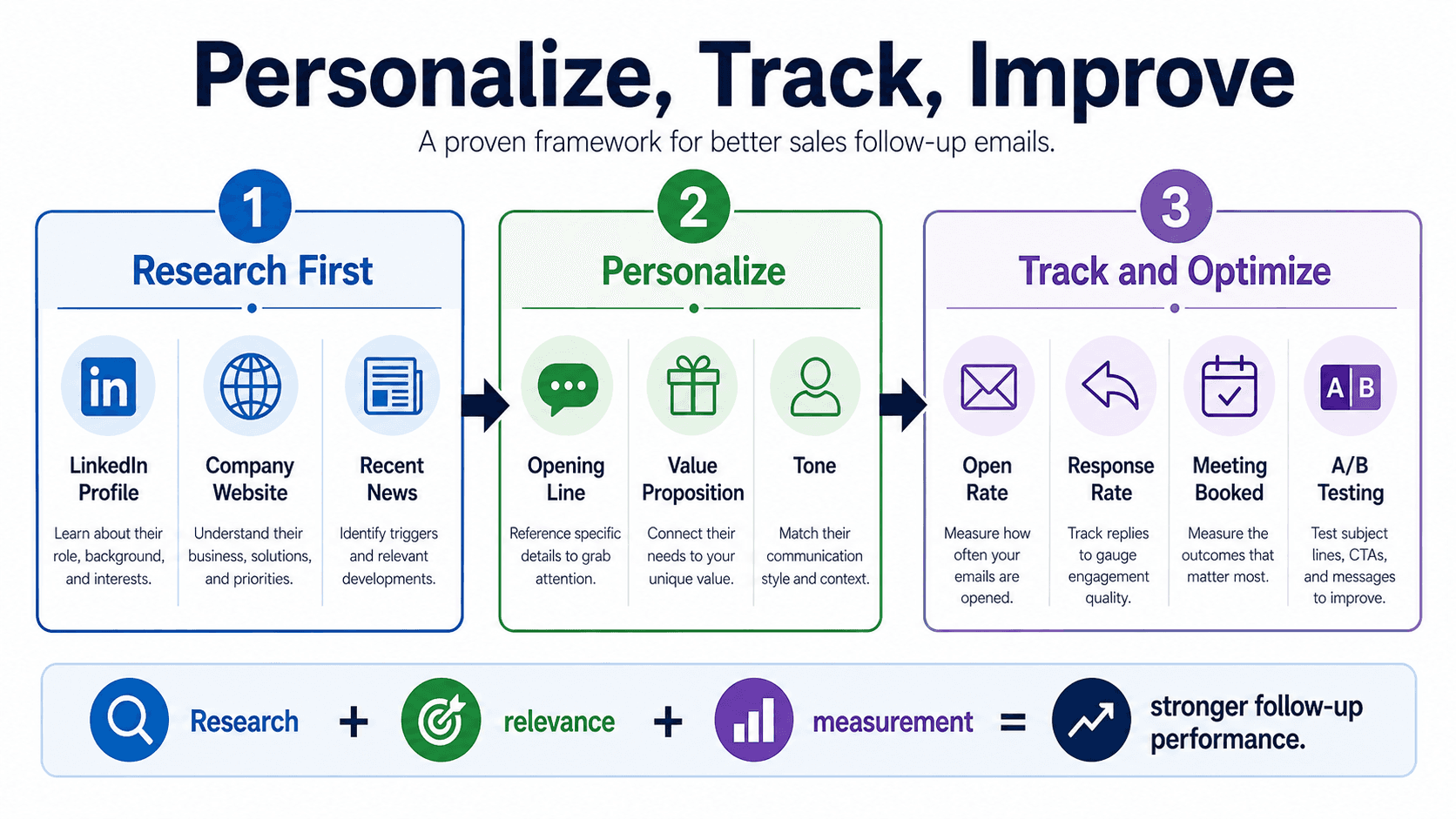
Review LinkedIn profile, check company website, read recent news, understand their role, identify potential challenges
Personalize Opening
Reference specific details, mention mutual connections, cite their content/posts, acknowledge their achievements
Tailor Value Proposition
Connect to their industry, address role-specific challenges, use relevant examples, speak their language
Adjust Tone
Match their communication style, consider company culture, adapt to industry norms, maintain professionalism
Tracking and Testing
Metrics to Monitor
Open rates, response rates, meeting booking rates, time to response, best-performing templates, optimal send times
A/B Testing
Test subject lines, vary email length, try different CTAs, test timing variations, experiment with personalization
Continuous Improvement
Analyze what works, update templates based on results, share wins across team, retire underperformers
Common Follow-Up Mistakes
Too Frequent: Daily follow-ups annoy prospects Too Infrequent: Monthly follow-ups lose momentum Too Salesy: Constant pitching repels interest Too Generic: Templates with no personalization get ignored Too Long: Walls of text overwhelm recipients No Value: Every touch should provide something useful
Automation and Cadences
Tools for Follow-Up: Outreach, SalesLoft, HubSpot, Mailchimp, Lemlist enable automated sequences while maintaining personalization
Effective Cadence Example:
Day 1: Initial outreach Day 3: Follow-up #1 (Template 1) Day 8: Follow-up #2 + value (Template 2) Day 15: Follow-up #3 new angle (Template 3) Day 23: Follow-up #4 social proof (Template 7) Day 30: Break-up email (Template 4)
Personalization at Scale: Use merge tags for custom fields, segment by industry/role, create scenario-based sequences, add manual touches for key prospects
Frequently Asked Questions
How many follow-ups before giving up? 5-7 touches over 3-4 weeks typical. Top performers do 8-12 touches over 2-3 months. Context matters higher value deals justify more persistence.
What's the best time to send follow-up emails? Tuesday-Thursday, 8-10 AM or 1-3 PM in prospect's timezone generally perform best. Test for your specific audience.
Should I call or email for follow-ups? Multi-channel works best. Combine emails with calls, LinkedIn messages, and other touchpoints. Email is less intrusive for initial follow-ups.
How do I avoid sounding desperate? Lead with value not need, maintain consistent timing, confidence in tone, provide easy outs, focus on their problems not your quota.
Can I use the same template for everyone? Base template yes, but customize with prospect-specific details, industry examples, relevant challenges. 70% template, 30% customization works well.
What if they ask me to stop emailing? Immediately honor request, apologize for persistence, offer alternative contact preferences, remove from sequence. CAN-SPAM compliance required.
Conclusion
Effective sales follow-up is systematic, persistent, and value-focused. The templates provided cover major scenarios from initial follow-ups through break-up emails, each designed to maintain engagement while respecting prospect time and inbox.
Success with follow-up requires balancing persistence with professionalism, providing value with every touch, personalizing templates meaningfully, testing and optimizing continuously, and tracking metrics rigorously.
Implement these templates by selecting appropriate ones for your scenarios, customizing with prospect-specific details, establishing consistent follow-up cadences, tracking what works, and refining based on results. Remember that most sales happen after multiple touches those who follow up systematically win while those who quit early lose.
The difference between top and average sales performers often comes down to follow-up discipline. Use these templates, maintain consistency, provide value at every touch, and persist professionally. Your conversion rates and revenue will reflect the effort invested in systematic, value-driven follow-up strategies.
Timeframe
2022 - 2023
Client
Escoba Inc.