What is a Sales Development Representative (SDR)? The Complete Career Guide
Introduction
Sales Development Representatives (SDRs) form the frontline of modern sales organizations, responsible for identifying and qualifying potential customers before passing them to closing teams. This specialized role has become critical as B2B sales processes grow more complex and companies recognize the efficiency gains from dividing prospecting from closing activities.
For job seekers, SDR positions offer entry points into lucrative sales careers with clear advancement paths. For businesses, effective SDR teams multiply pipeline generation and sales productivity. Understanding what SDRs do, the skills required, compensation structures, and career progression helps both individuals and organizations succeed.
Primary Keyword: Sales Development Representative
Secondary Keywords: SDR role, SDR responsibilities, sales development, SDR career, SDR skills, SDR salary Keyword Clusters: Job responsibilities, required skills, compensation, career path, success metrics
What is a Sales Development Representative?

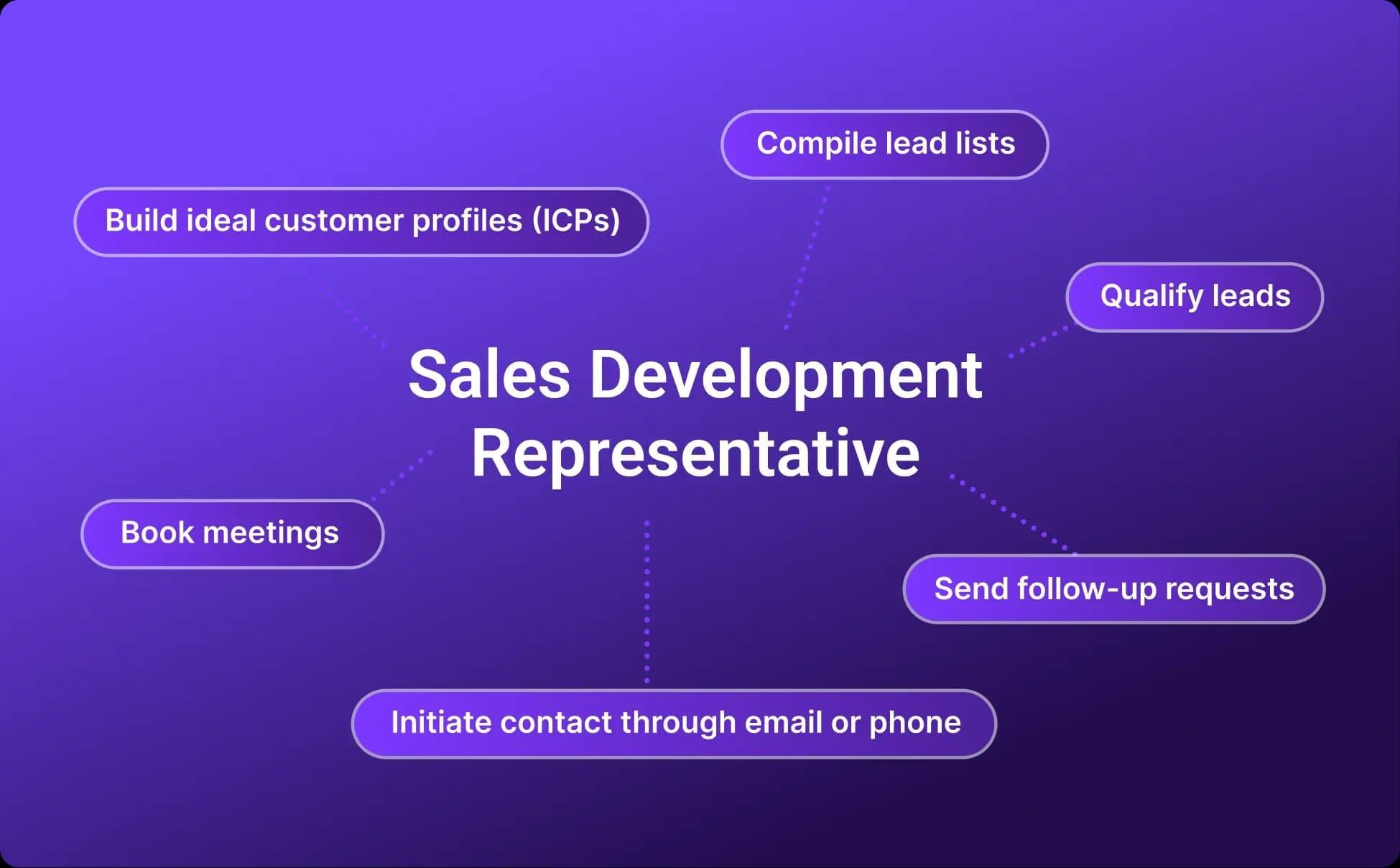
A Sales Development Representative (SDR) is a sales professional focused exclusively on outbound prospecting and inbound lead qualification. SDRs identify potential customers, initiate contact, assess fit and interest, and schedule meetings or demos for Account Executives who handle the closing process.
Core Responsibilities
Outbound Prospecting: Research target accounts, identify decision-makers, craft personalized outreach via email, phone, and social media.
Inbound Lead Qualification: Respond to marketing-generated leads, assess quality and fit, determine readiness for sales conversations.
Needs Discovery: Conduct initial conversations understanding prospect challenges, goals, timeline, and budget.
Meeting Setting: Schedule qualified prospects for demonstrations or consultative sales calls with Account Executives.
CRM Management: Maintain accurate records of all activities, communications, and prospect information.
Collaboration: Work closely with marketing on campaign effectiveness and with sales on lead quality and handoff processes.
SDR vs. BDR vs. Account Executive
Understanding role distinctions clarifies the SDR position
SDR (Sales Development Representative): Focus: Outbound prospecting and inbound lead qualification Goal: Generate qualified meetings for closing team Typical territory: Assigned accounts or geographic regions
BDR (Business Development Representative): Focus: Similar to SDR; some organizations use terms interchangeably Distinction: BDRs sometimes focus more on strategic accounts or partnerships Goal: Same as SDR - qualified opportunity generation
Account Executive (AE): Focus: Closing deals and managing sales cycles Goal: Convert qualified opportunities into customers and revenue Receives: Qualified leads from SDRs/BDRs
Lead Development Representative (LDR): Focus: Exclusively inbound lead qualification Goal: Qualify marketing-generated leads for sales team
Key SDR Responsibilities and Daily Activities

Prospecting and Research (30-40% of time)
Identify target accounts fitting ideal customer profile, research company information and recent news, find decision-makers and contact information, understand prospect pain points and triggers.
Outreach and Communication (40-50% of time)
Make 50-100 outbound calls daily, send 50-80 personalized emails, engage on LinkedIn and social platforms, follow up on previous conversations, respond to inbound inquiries within minutes.
Qualification and Discovery (10-20% of time)
Conduct discovery calls assessing fit, understand budget and timeline, identify decision-making process, determine if prospect meets qualification criteria (BANT, MEDDIC, or custom framework).
Administrative Tasks (10-20% of time)
Update CRM with activities and notes, schedule meetings between prospects and AEs, attend team meetings and training, report on metrics and pipeline.
Essential SDR Skills
Communication Skills
Clear verbal and written communication, active listening without interrupting, ability to build rapport quickly, adapting communication style to different personalities, storytelling that engages prospects.
Resilience and Persistence
Handling rejection without discouragement (90%+ of outreach receives no response), maintaining energy and enthusiasm through repetitive tasks, bouncing back from difficult conversations, consistently hitting activity metrics.
Research and Preparation
Quickly finding relevant information about companies and contacts, identifying business challenges your solution addresses, personalizing outreach with specific details, staying current on industry trends.
Time Management
Balancing high activity volume with quality, prioritizing highest-potential prospects, efficiently managing email and call blocks, meeting multiple daily, weekly, and monthly goals.
Technical Aptitude
CRM systems (Salesforce, HubSpot), sales engagement platforms (Outreach, SalesLoft), LinkedIn Sales Navigator, email automation tools, video messaging platforms.
Qualification Framework Knowledge
Understanding BANT (Budget, Authority, Need, Timeline), MEDDIC (Metrics, Economic Buyer, Decision Criteria, Decision Process, Identify Pain, Champion), or company-specific qualification criteria.
SDR Compensation and Earnings
Typical Compensation Structure
Base Salary: $40,000-$60,000 (varies by location and company size) On-Target Earnings (OTE): $60,000-$90,000 (base + commission at quota) Top Performers: $80,000-$120,000+ with accelerators
Commission Structure
Paid per qualified meeting set, per SQL (Sales Qualified Lead) created, per closed deal (sometimes), monthly or quarterly bonuses for exceeding quota.
Additional Compensation
Stock options or equity (especially at startups), quarterly President's Club trips for top performers, SPIFF bonuses for specific campaigns or results, career development and training programs.
Geographic Variations
San Francisco/NYC: $70K-$100K+ OTE Mid-tier cities: $60K-$80K OTE Lower cost areas: $50K-$70K OTE
Factors Affecting Compensation
Company size and funding stage, industry (tech typically pays more), deal size and sales cycle length, individual performance and tenure.
Career Path and Advancement
SDR roles typically serve as 12-24 month positions leading to advancement:
Typical Progression
Entry: SDR/BDR (12-18 months) ↓ Mid-Level: Senior SDR or Team Lead (12-18 months) ↓ Advancement: Account Executive, closing deals ↓ Management: Sales Management or SDR Manager ↓ Leadership: Director/VP of Sales
Alternative Paths
Customer Success Manager, Marketing (demand generation, content), Sales Operations or Enablement, Account Management, Product Management (understanding customer needs).
Timeline Expectations
High performers: Promoted to AE within 12 months Average performers: 18-24 months as SDR Top companies: Clear promotion criteria and timelines Some organizations: SDR as permanent role with different focus
How to Succeed as an SDR
Master the Fundamentals
Consistently hit activity metrics (calls, emails, social touches), maintain pipeline of active prospects, achieve meeting booking and qualification quotas, keep CRM meticulously updated.
Develop Product Expertise
Deeply understand your solution's value proposition, learn customer use cases and success stories, stay current on product updates and features, articulate differentiation from competitors.
Refine Your Process
Test different messaging approaches, optimize call times and email send times, develop effective objection handling, create personalized templates that scale, leverage tools efficiently.
Build Relationships
Develop rapport with Account Executives, collaborate with marketing on feedback, network with successful reps, find mentors within organization.
Focus on Quality, Not Just Quantity
Better to book 15 highly qualified meetings than 30 poor-fit prospects, understand ideal customer profile deeply, disqualify bad fits quickly, set realistic expectations with prospects.
Continuous Learning
Read sales books and blogs, listen to recorded calls, attend training sessions, seek feedback proactively, experiment with new approaches.
SDR Metrics and KPIs
Activity Metrics
Calls made per day (typically 50-100), emails sent (50-80), LinkedIn connection requests, social media touches.
Results Metrics
Meetings booked per week/month, Sales Qualified Leads created, Conversion rate from contact to meeting, Pipeline generated for AE team.
Quality Metrics
Meeting show rate (should be 70%+), SQL acceptance rate by AEs, Deal win rate from SDR-sourced leads, Average contract value of closed deals.
Efficiency Metrics
Time to first response (inbound leads), Activities required per meeting booked, Cost per qualified lead, Ramp time to full productivity.
Tools SDRs Use Daily
CRM Systems: Salesforce, HubSpot, Pipedrive for contact and activity management
Sales Engagement: Outreach, SalesLoft, Salesloft for automated sequences and cadences
Prospecting Tools: LinkedIn Sales Navigator, ZoomInfo, Apollo for finding contacts
Communication: Phone systems, video tools (Loom, Vidyard), email tracking
Intelligence: Company research tools, news alerts, intent data platforms
Productivity: Calendar scheduling (Calendly), note-taking, task management

Breaking Into an SDR Role
No Experience Required
Many companies hire entry-level SDRs with no sales experience, looking for coachability, work ethic, and communication skills.
Backgrounds That Translate
Customer service, retail, hospitality (customer interaction experience), college athletics (competitive drive, team player), entrepreneurship (self-motivation).
How to Stand Out
Research the company thoroughly, demonstrate understanding of their product and market, show enthusiasm and coachability, highlight relevant skills (communication, resilience), be persistent in follow-up during application process.
Interview Preparation
Practice cold calling during interviews, prepare questions showing research, demonstrate active listening, show understanding of sales process, express long-term career goals in sales.
Frequently Asked Questions
Is being an SDR a good career? Yes for people wanting sales careers. SDR roles offer excellent learning, clear advancement paths, strong earning potential, and transferable skills. Expect hard work, rejection, and repetition, but successful SDRs advance quickly to higher-paying closing roles.
How hard is it to be an SDR? Challenging due to high rejection rates, repetitive tasks, and aggressive quotas. However, structured environments with good training, tools, and supportive teams make success achievable for motivated individuals.
What's the typical SDR quota? Varies widely: 15-25 qualified meetings per month, 20-40 Sales Qualified Leads per quarter, or pipeline generation targets ($50K-$200K per quarter). Quotas depend on deal size, sales cycle, and company expectations.
Can you make good money as an SDR? Yes. Top performers earn $80K-$120K+ in their first year, especially in tech. Career progression to AE typically brings $100K-$200K+ OTE within 2-3 years.
Do SDRs work from home? Increasingly yes post-COVID. Many companies offer hybrid or fully remote SDR positions. Some maintain office requirements for training and culture. Remote work requires strong self-discipline and time management.
What's the difference between inside sales and SDR? Inside sales conducts entire sales process remotely (prospecting through closing). SDRs focus only on prospecting and qualification, passing opportunities to closers. Some use terms interchangeably.
Conclusion
Sales Development Representatives play a critical role in modern B2B sales organizations, serving as the engine driving pipeline generation and revenue growth. For individuals, SDR positions offer accessible entry points into lucrative sales careers with clear advancement paths, strong earning potential, and transferable skills applicable across industries.
Success as an SDR requires resilience, communication skills, time management, and consistent execution of fundamentals. The role involves significant rejection and repetition but rewards those who persist with rapid career advancement and financial growth.
For companies, effective SDR teams multiply sales productivity by allowing Account Executives to focus on closing deals while specialized prospectors fill the pipeline with qualified opportunities. Investing in SDR training, tools, and career development pays dividends in revenue growth and sales team performance.
Whether you're considering an SDR care
er, managing an SDR team, or building sales development functions, understanding the role's responsibilities, required skills, compensation structures, and success factors enables better decisions and improved outcomes. The SDR role will continue evolving with technology and market changes, but its core function connecting potential customers with solutions to their problems remains fundamental to business growth.
Timeframe
2022 - 2023
Client
Escoba Inc.